Author: Arman

  • The Role of Data Analytics in Automotive Industry Transformation

    In the modern automotive landscape, data analytics has emerged as a powerful tool driving innovation, efficiency, and customer satisfaction. From manufacturing processes to vehicle performance monitoring and customer experience enhancement, the automotive industry is increasingly leveraging data analytics to gain insights, make informed decisions, and stay competitive in a rapidly evolving market. This article explores the multifaceted role of data analytics in transforming the automotive industry and shaping its future trajectory.

    Manufacturing Optimization: From Production Lines to Supply Chains Data analytics plays a pivotal role in optimizing manufacturing processes, improving productivity, and reducing costs throughout the automotive supply chain. By analyzing production data in real-time, manufacturers can identify inefficiencies, streamline workflows, and optimize resource allocation. Predictive analytics enables proactive maintenance of machinery and equipment, minimizing downtime and preventing costly disruptions. Additionally, data analytics helps optimize inventory management, demand forecasting, and logistics, ensuring timely delivery of parts and components while minimizing inventory holding costs.

    Vehicle Performance Monitoring: Enhancing Reliability and Efficiency In the age of connected vehicles, data analytics enables real-time monitoring of vehicle performance, driving behavior, and maintenance needs. Telematics systems collect and analyze data from sensors embedded in vehicles, providing valuable insights into fuel efficiency, engine health, tire wear, and other crucial metrics. By leveraging machine learning algorithms, automakers can predict potential failures, schedule proactive maintenance, and optimize vehicle performance based on driving patterns and environmental conditions. This proactive approach to maintenance not only improves vehicle reliability but also enhances safety and reduces operating costs for both consumers and fleet operators.

    Customer Experience Enhancement: Personalization and Predictive Insights Data analytics empowers automakers to better understand customer preferences, behavior, and sentiment, enabling them to deliver personalized products and services tailored to individual needs. By analyzing data from connected vehicles, customer interactions, and social media platforms, automakers can gain insights into customer preferences, trends, and feedback, informing product development, marketing strategies, and customer engagement initiatives. Predictive analytics enables automakers to anticipate customer needs, recommend relevant products and services, and provide proactive support, fostering loyalty and satisfaction throughout the ownership lifecycle.

    Safety and Autonomous Driving: Leveraging Big Data for Safer Roads Data analytics plays a critical role in advancing safety and autonomous driving technologies, leveraging big data to train AI models, validate algorithms, and improve decision-making in real-world scenarios. By analyzing vast amounts of sensor data, including lidar, radar, and camera feeds, researchers can develop more accurate perception systems, enabling autonomous vehicles to navigate complex environments and react to unexpected events safely. Additionally, data analytics enables the aggregation and analysis of data from vehicle-to-vehicle (V2V) and vehicle-to-infrastructure (V2I) communication systems, enhancing situational awareness and enabling collaborative decision-making to prevent accidents and optimize traffic flow.

    Conclusion: Data analytics is transforming every aspect of the automotive industry, from manufacturing and vehicle performance monitoring to customer experience enhancement and autonomous driving. By harnessing the power of data, automakers can optimize operations, enhance product offerings, and improve safety and efficiency across the entire automotive ecosystem. As data analytics technologies continue to evolve and mature, the automotive industry is poised to enter a new era of innovation, connectivity, and sustainability, driving towards a future of safer, smarter, and more personalized mobility solutions.

  • The Impact of Artificial Intelligence on Automobile Design and Functionality

    Artificial intelligence (AI) has emerged as a driving force behind innovation in various industries, and the automotive sector is no exception. From design and manufacturing to driving assistance and predictive maintenance, AI is revolutionizing every aspect of automobile development and functionality. This article explores the profound impact of AI on automobiles and how it is shaping the future of transportation.

    Design and Engineering: Enhancing Creativity and Efficiency AI is revolutionizing the design and engineering process by offering designers and engineers powerful tools to streamline workflows, optimize designs, and explore new possibilities. Generative design algorithms, powered by AI, enable designers to input parameters and constraints and generate thousands of design variations, helping to uncover innovative solutions that human designers might overlook. Additionally, AI-driven simulation tools allow engineers to conduct virtual tests and optimizations, reducing the need for physical prototypes and speeding up the development cycle.

    Safety and Driver Assistance: Towards Safer Roads AI plays a crucial role in improving vehicle safety through advanced driver assistance systems (ADAS) that leverage machine learning algorithms to detect and respond to potential hazards on the road. Features such as adaptive cruise control, lane-keeping assist, and automatic emergency braking rely on AI-powered sensors and cameras to monitor the vehicle’s surroundings and assist the driver in avoiding accidents. As AI algorithms continue to improve in accuracy and reliability, ADAS technologies are becoming increasingly sophisticated, paving the way towards autonomous driving.

    Autonomous Driving: Redefining Mobility At the forefront of AI’s impact on automobiles is the development of autonomous driving technology, which promises to revolutionize the way we travel. Autonomous vehicles (AVs) use a combination of sensors, cameras, and AI algorithms to perceive the environment, make decisions, and navigate safely without human intervention. Companies ranging from traditional automakers to tech giants are investing billions of dollars in developing AV technology, with the aim of achieving fully autonomous operation in the near future. Beyond personal transportation, autonomous vehicles hold the potential to transform industries such as ride-hailing, delivery services, and logistics, unlocking new opportunities for efficiency and convenience.

    Predictive Maintenance: Maximizing Vehicle Reliability AI-powered predictive maintenance systems are enabling automakers and fleet operators to monitor the health of vehicles in real-time and proactively address potential issues before they lead to breakdowns or failures. By analyzing data from sensors, onboard diagnostics, and historical maintenance records, AI algorithms can identify patterns and anomalies indicative of impending component failures or maintenance needs. This proactive approach to maintenance not only reduces downtime and repair costs but also improves overall vehicle reliability and safety.

    Conclusion: The integration of artificial intelligence into automobiles is reshaping the automotive industry, driving innovation, improving safety, and redefining the concept of mobility. From design and engineering to safety features, autonomous driving, and predictive maintenance, AI is revolutionizing every aspect of automobile development and functionality. As AI technologies continue to advance and become more pervasive, the future of transportation promises to be safer, more efficient, and more connected than ever before.

  • The Future of Automobiles: Trends and Technologies Shaping the Next Decade

    The automotive industry stands on the cusp of a transformative era, driven by rapid technological advancements and shifting consumer preferences. From electric propulsion to connected vehicles and autonomous driving systems, a myriad of trends and technologies are poised to shape the future of automobiles in the coming decade. This article explores some of the key developments driving this evolution and their potential implications for the automotive landscape.

    Electric Revolution: Towards Sustainable Mobility The push towards electrification represents one of the most significant shifts in the automotive industry. With growing concerns over climate change and air pollution, governments around the world are implementing stricter emissions regulations, incentivizing the adoption of electric vehicles (EVs). Major automakers are investing heavily in electric propulsion technology, developing EV platforms and expanding their electric vehicle offerings. The continued advancement of battery technology, including solid-state batteries and fast-charging infrastructure, is key to overcoming range anxiety and accelerating the transition to electric mobility.

    Connected Cars: The Era of Smart Vehicles The proliferation of connected car technology is transforming vehicles into interconnected hubs of data and communication. Through onboard sensors, GPS navigation systems, and wireless connectivity, cars are becoming increasingly integrated with the digital world. Connected vehicles enable features such as real-time traffic updates, remote diagnostics, and over-the-air software updates, enhancing convenience, safety, and efficiency for drivers. As connectivity becomes more ubiquitous, automakers are exploring opportunities to leverage data analytics and artificial intelligence to deliver personalized services and predictive maintenance solutions.

    Autonomous Driving: Redefining the Concept of Mobility Autonomous driving technology promises to revolutionize the way we think about transportation, offering the potential to enhance safety, efficiency, and accessibility on the roads. While fully autonomous vehicles are still in the developmental stages, advanced driver assistance systems (ADAS) equipped with features such as adaptive cruise control, lane-keeping assist, and automated parking are already available in many new vehicles. As the technology matures and regulatory frameworks evolve, autonomous vehicles are expected to play a prominent role in future mobility ecosystems, enabling new business models such as ride-hailing services and shared autonomous fleets.

    Sustainable Manufacturing: Embracing Circular Economy Principles In addition to transforming the way vehicles are powered and driven, the automotive industry is also undergoing a paradigm shift towards sustainable manufacturing practices. Automakers are increasingly adopting circular economy principles, focusing on reducing waste, recycling materials, and minimizing environmental impact throughout the product lifecycle. From lightweight materials and eco-friendly production processes to closed-loop recycling systems, manufacturers are exploring innovative approaches to make cars more sustainable from cradle to grave.

    Conclusion: The future of automobiles is poised to be shaped by a convergence of technological innovations, regulatory changes, and evolving consumer preferences. From electric propulsion and connected vehicles to autonomous driving systems and sustainable manufacturing practices, the automotive industry is undergoing a period of profound transformation. As stakeholders across the automotive ecosystem collaborate to address the challenges and opportunities of the future, the stage is set for a new era of mobility that is safer, cleaner, and more efficient than ever before.

  • The Evolution of Automobile Technology: From Horseless Carriages to Autonomous Vehicles

    The automobile, one of the most revolutionary inventions of the 19th century, has undergone significant transformations since its inception. From the earliest horseless carriages to the cutting-edge autonomous vehicles of today, the journey of automotive technology has been marked by innovation, creativity, and relentless pursuit of efficiency and safety. This article delves into the evolution of car technology, tracing its fascinating progression through the decades.

    The Early Years: Horseless Carriages and the Birth of the Automotive Industry The concept of a self-propelled vehicle dates back to the late 18th century, but it wasn’t until the late 19th century that the first practical automobiles began to emerge. Pioneers such as Karl Benz, Gottlieb Daimler, and Henry Ford played instrumental roles in the development of early automobiles, introducing innovations such as the internal combustion engine, the assembly line manufacturing process, and the Model T Ford, which revolutionized personal transportation.

    The Rise of Mass Production and Standardization With the advent of mass production techniques pioneered by Henry Ford in the early 20th century, automobiles became more affordable and accessible to the general public. Mass production allowed for standardization of parts, making repairs and maintenance easier and more cost-effective. This era also saw the introduction of features such as electric starters, headlights, and windshield wipers, which further improved the convenience and safety of automobiles.

    Technological Innovations: From Carburetors to Fuel Injection Throughout the 20th century, automotive engineers continued to refine and improve upon existing technologies. Innovations such as carburetors, which controlled the air-fuel mixture in internal combustion engines, gave way to more efficient fuel injection systems. Electronic fuel injection, introduced in the 1980s, provided better fuel economy, lower emissions, and improved engine performance compared to traditional carburetors.

    Safety Advancements: Seat Belts, Airbags, and Advanced Driver Assistance Systems In addition to advancements in performance and efficiency, automotive technology has also made significant strides in enhancing safety for both drivers and passengers. The introduction of seat belts in the 1950s marked a major milestone in automotive safety, reducing the risk of injury in the event of a collision. Subsequent innovations such as airbags, anti-lock braking systems (ABS), and traction control systems further improved crash survivability and vehicle stability.

    The Dawn of the Electric Vehicle Era In recent years, the automotive industry has witnessed a resurgence of interest in electric vehicles (EVs) as concerns about climate change and environmental sustainability have grown. Major automakers have invested heavily in developing electric powertrains and battery technology, leading to the proliferation of EV models with longer ranges and faster charging times. Additionally, advancements in autonomous driving technology have paved the way for self-driving electric vehicles, promising safer and more efficient transportation solutions for the future.

    The evolution of automobile technology is a testament to human ingenuity and innovation. From humble beginnings as horseless carriages to the sophisticated vehicles of today, cars have transformed the way we live, work, and travel. As we look to the future, continued advancements in electric propulsion, autonomous driving, and connectivity are poised to reshape the automotive industry once again, ushering in a new era of mobility that is safer, cleaner, and more sustainable than ever before.

  • Què són els acords d’Europa amb tercers que perjudiquen la pagesia i confronten ERC i Junts?

    Les protestes dels pagesos catalans no han anat soles. Companys de tota Europa s’han manifestat en les últimes setmanes perquè part de les reivindicacions van més enllà de les administracions locals o nacionals, si no que tenen com a principal responsable la UnióEuropea. Un dels temes de debat en aquesta escala són els acords europeus amb tercers països, que perjudiquen la pagesia catalana i confronten ERC Junts.

    El problema de fons d’aquests acords són que els pagesos europeus consideren que es tracten de competència deslleial, ja que hi ha països importadors que no compleixen les mateixes condicions exigides a les produccions dels que són membres de la Unió Europea. Tampoc se secunden, asseguren els pagesos del Vell Continent, les condicions del sistema de les assegurances agràries, ineficaces per a la protecció de les rendes de la pagesia. Reclamen que s’acabi amb aquests greuges.

    “Es necessita una revisió dels tractats de comerç d’Europa amb tercers països”, deia el president PereAragonès al ple del Parlament d’aquest dimecres. ERC ha recollit una de les demandes dels pagesos catalans i europeus per defensar la seva actuació al Parlament Europeu. La seva portaveu en aquest cambra, Diana Riba, va ser l’encarregada d’exposar el pensament dels republicans pel que fa a aquests acords amb tercers països.

    Riba, a través de les xarxes socials, ha recollit les votacions dels últims anys en aquest sentit, on els republicans han votat en contra dels acords amb el CanadàVietnamXileMercosur (bloc comercial integrat pel Brasil, l’Argentina, l’UruguaiParaguai Veneçuela) i ara treballen perquè no tiri endavant el pacte comercial amb Mèxic. “Són contraproduents tant pel clima com per al comerç local i els drets humans”, ha assegurat la portaveu republicana a Europa. ERC sí que ha votat a favor de l’acord amb Nova Zelanda perquè considera que sí que es compleixen els “factors de sostenibilitat i responsabilitat social”.

    Però el que deixava entreveure també els gràfics de votacions que exposava Riba és el diferent criteri pel qual havia optat Junts. “Bastir bones relacions comercials amb altres democràcies és clau perquè el nostre sector agroalimentari pugui comerciar-hi sense sobresalts”, defensava Carles Puigdemont a l’antic Twitter, en un posicionament sectorial que dista dels pronunciaments en clau nacional que sol expressar l’eurodiputat a través de les xarxes socials.

    Junts i Lliures per Europa, la marca europea del partit, també ha defensat el seu posicionament sobre aquests acords, recordant que no han donat suport als tractats amb Vietnam, la Xina, Angola o Sud-àfrica. Per altra banda, sí que defensen el vot favorable a l’acord amb el Canadà perquè “ha augmentat la inversió” a Catalunya i els que s’han establert amb els països de Llatinoamèrica “en clau nacional”. “Rebutjar aquests acords resultaria una irresponsabilitat, especialment si es fa des del Govern de Catalunya”, apunta la formació de Puigdemont.

    Arran de les protestes de la pagesia a tot el continent, Europa ha admès ara que “no es donen les condicions” per tancar l’acord comercial amb Mercosur. En la mateixa línia de calmar els ànims del sector, Brussel·les també ha anunciat que retirarà la proposta de reduir a la meitat l’ús de pesticides, una altra de les polítiques per les quals es manifesten els pagesos. “Treballen cada dia de valent per produir aliments de qualitat, i és per això que mereixen el nostre agraïment i respecte”, va apuntar la presidenta de la Comissió EuropeaUrsula von der Leyen.

  • Divya Deshmukh: India chess player’s Instagram post sparks sexism discussion

    By Cherylann Mollan

    BBC News, Mumbai

    An 18-year-old Indian chess player has sparked a conversation on attitudes towards women in the sport with an Instagram post about her experiences.

    Divya Deshmukh, who is an International Master (the second-highest title in chess), said that her chess videos often received online comments that focused on her appearance rather than her games.

    “It’s a sad truth that when women play chess, [people] often overlook how good they actually are… and every irrelevant thing is focused on,” she wrote, adding that she had wanted to address the issue “for a while”.

    Deshmukh shared the post at the end of the recent Tata Steel Chess tournament held in the Netherlands as she said that the behaviour of the audience had irked her throughout the competition. The organisers of the tournament later issued a statement supporting her and said that they “remain committed to promoting women in chess and ensuring a safe and equal sporting environment”.

    Sexism is still an under-discussed topic in chess, which is one of the few mainstream sports where men and women often compete against each other. Deshmukh’s post, experts say, has ignited a crucial conversation on the behaviour of fans and even male players towards women in chess – even Susan Polgar, the world’s first woman grandmaster, joined in.

    Deshmukh told the BBC that she has been receiving hateful comments related to the way she dresses, looks or speaks since she was 14 years old. “It makes me sad that people don’t pay the same kind of attention to my chess skills,” she said.

    Thousands of people have liked her post, and many have left supportive comments. One Reddit user noted how even seemingly innocuous jokes and comments were often “laced with sexist attitudes” while another said that it was common for people to leave sexually suggestive remarks under videos featuring women players.

    “With an increase in online tournaments and with games being livestreamed, women players have become disproportionately vulnerable to receiving misogynistic comments from the predominantly male audience online,” says sports writer Susan Ninan, who has written extensively about chess.

    She adds that such trolling deepens sexist attitudes about chess and can impact the confidence of young women players.

    As a sport, chess already has a poor gender balance. According to the International Chess Federation or FIDE, women make up just 10% of licenced players globally, and the gap only gets wider at the top. For example, only three of India’s 84 grandmasters are women.

    Chess experts and women players have ascribed this imbalance to the lack of access, opportunity and support for women and girls due to stereotypes surrounding the sport.

    “There’s this common misconception that men are ‘wired differently’ and are hence, inherently better at chess,” says Ms Ninan, adding that such beliefs are amplified online, feeding into existing socio-cultural biases people have about women and their intellectual abilities.

    Women in chess
    Image caption,Koneru Humpy is one of India’s top chess players

    In a study conducted by researchers at New York University for which around 300 parents and mentors – 90% of these were men – were interviewed, it was found that a majority of the respondents believed that girls have a lower potential in the sport than boys and that they were more likely to stop playing chess due to a lack of ability than their male counterparts.

    Nandhini Saripalli, a chess player and coach, says she has experienced first-hand the consequences of such biases. She says that her chess career took a hit because she didn’t get enough support compared with her male counterparts.

    And now, she says that her career as a coach is being hampered because society doesn’t have much confidence in a woman’s chess-playing ability. “Parents want their children to be mentored by a male coach because they feel that male players are more talented,” she says.

    Observers also say that online trolling feeds into the culture of women players and tournaments not being taken seriously.

    Saripalli says that online, she has had men telling her that her male opponent can “trash” her easily, while offline, she has encountered male players who’ve said that they don’t feel the need to practise if their opponent is a woman because they don’t consider female players to be “real competition”.

    “Women have to work twice as hard to prove themselves, and even then you can’t escape sexist judgements,” she says, adding that like many of her female chess-playing friends, she too “dresses down” to escape unwanted attention from male players and the audience.

    Women in chess
    Image caption,Nandhini Saripalli says she feels she was held back as a player because of her gender

    Interestingly, this is something Polgar – who is widely regarded to be among the best chess players in the world – says she experienced decades ago when she was a young chess player.

    Polgar responded to Ms Deshmukh’s post by sharing her own experience on X (formerly Twitter). “I did not even touch make-up until I was in my 20s… It is because I was tired of being sexually harassed/assaulted and hit on constantly by male chess players,” she wrote.

    Ms Ninan says that chess offers a “fertile space for predatory behaviour” because of its one-on-one setting and the fact that players are just a chess board away from their opponent.

    But Koneru Humpy, one of India’s top chess players who started her career in the 1990s when there were few women in chess, and stunned the world by becoming the then-youngest female Grandmaster at the age of 15 (this record was broken later), says that there is more equality now compared with when she began playing.

    Humpy recalls being the only female player to compete in open tournaments – she says these are much tougher to win than women’s-only tournaments because the players are more skilled on average.

    “Men wouldn’t like losing to me because I’m a woman,” she says and adds that today’s crop of male players are different as they regularly train and play against their female peers.

    But it will take more time for women players to wield the same amount of influence on and off the chess board as their male counterparts. One way to alter this power imbalance is to remove socio-cultural barriers that prevent women’s participation in chess at the entry level.

    “Once there are more female players, there will be more of them in the top levels of the sport,” says Humpy, adding that this will change prevailing perceptions.

    The other way to encourage more women to play chess is by increasing the number of women-only tournaments.

    “The more women play chess, the more claim they have over the sport,” she adds.

  • Mount Everest: Climbers will need to bring poo back to base camp

    By Navin Singh Khadka

    Environment correspondent, BBC World Service

    People climbing Mount Everest will now have to clear up their own poo and bring it back to base camp to be disposed of, authorities have said.

    “Our mountains have begun to stink,” Mingma Sherpa, chairman of Pasang Lhamu rural municipality, told the BBC.

    The municipality, which covers most of the Everest region, has introduced the new rule as part of wider measures being implemented.

    Due to extreme temperatures, excrement left on Everest does not fully degrade.

    “We are getting complaints that human stools are visible on rocks and some climbers are falling sick. This is not acceptable and erodes our image,” Mr Mingma adds.

    Climbers attempting Mount Everest, the world’s tallest peak, and nearby Mount Lhotse will be ordered to buy so-called poo bags at base camp, which will be “checked upon their return”.

    Where do you poo up a mountain?

    During climbing season mountaineers spend most of their time at base camp acclimatising to the altitude, where separate tents are erected as toilets, with barrels underneath collecting the excrement.

    But once they begin their treacherous journey things get more difficult.

    Most climbers and support staff tend to dig a hole but the higher you go up the mountain, some locations have less snow, so you have to go to the toilet out in the open.

    Very few people bring their excrement back in biodegradable bags when climbing Mount Everest’s summit, which can take weeks.

    Rubbish remains a huge issue on Everest and other mountains in the region, although there has been an increasing number of clean-up campaigns, including an annual one led by the Nepali Army.

    A member of a clean-up campaign clearing rubbish left behind at Camp Three
    Image caption,Clean-up campaigns have led to the removal of some rubbish, but that is mostly in lower camps

    ‘Open toilet’

    “Waste remains a major issue, especially in higher up camps where you can’t reach,” says Chhiring Sherpa, Chief Executive Officer of the non-government organisation Sagarmatha Pollution Control Committee (SPCC).

    Although no official figure exists, his organisation estimates that there are around three tonnes of human excrement between camp one at the bottom of Everest and camp four, towards the summit.

    “Half of that is believed to be in South Col, also known as camp four,” Mr Chhiring says.

    Stephan Keck, an international mountain guide who also organises expeditions to Everest, said South Col has gained a reputation as an “open toilet”.

    At 7,906 metres (25,938 feet) high, South Col serves as the base before climbers attempt to reach the Everest and Lhotse summits. Here, the terrain is very windswept.

    “There is hardly any ice and snow, so you will see human stools all around,” Mr Keck says.

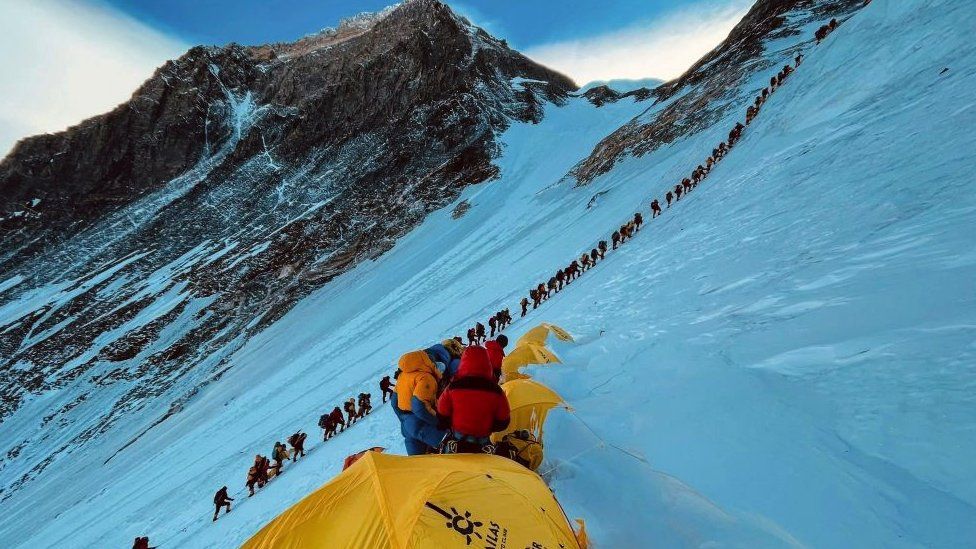
    This photograph taken on May 31, 2021 shows mountaineers lined up as they climb a slope during their ascend to summit Mount Everest (8,848.86-metre), in Nepal
    Image caption,The rising number of climbers means there has been a significant increase in waste on Everest

    Authorised by the Pasang Lhamu rural municipality, the SPCC is now procuring about 8,000 poo bags from the US, for an estimated 400 foreign climbers and 800 support staff for the upcoming climbing season that begins in March.

    These poo bags contain chemicals and powders that solidify human excrement and make it largely odourless.

    On average, a climber is thought to produce 250 grams of excrement per day. They usually spend about two weeks on the higher camps for the summit attempt.

    “With that as the basis, we plan to give them two bags, each of which they can use five to six times,” Mr Chhiring explains.

    “It certainly is a positive thing, and we will be happy to play our part to make this successful,” says Dambar Parajuli, president of the Expedition Operators Association of Nepal.

    He said his organisation had suggested that this should first be brought in as a pilot project on Everest and then replicated on other mountains too.

    Mingma Sherpa, the first Nepali to have climbed all 14 mountains above 8,000 metres, said use of such bags to manage human waste has been tried and tested on other mountains.

    “Mountaineers have been using such bags on Mount Denali (the highest peak in North America) and in the Antarctic as well, that is why we have been advocating for it,” says Mr Mingma, who is also an advisor to the Nepal Mountaineering Association.

    Mr Keck, the international mountain guide, echoed the same message, saying the idea will help to clean up the mountain.

    Ladders being collected at Camp Three of Mount Everest
    Image caption,Ropes and ladders left behind by climbers are collected and brought back, but human excrement remains on the mountains

    Nepal’s central government has announced several mountaineering rules in the past but there has been criticism that many of them have not been properly implemented.

    One of the main reasons is the absence of liaison officers on the ground. Government officials are supposed to be with expedition teams at the base camps but many of them have been criticised for not showing up.

    “The state has always been missing at base camps leading to all kinds of irregularities including people climbing our mountains without permits,” Mr Mingma, chairman of the Pasang Lhamu rural municipality, says.

    “This will all change now. We will run a contact office and make sure our new measures, including making climbers bring back their excrement, are implemented.”

  • bbc – ‘We are surrounded’: Guarding the Middle East’s most dangerous border

    By Jeremy Bowen

    International editor, Metula

    It is a lonely drive to Israel’s most northern town, Metula, along a spur of land that is surrounded on three sides by Lebanon. That means it is also surrounded on three sides by Lebanon’s most powerful armed group, Hezbollah.

    The soldiers at the checkpoint on the edge of Metula were all local men, mostly middle-aged reservists with no illusions about the force on the other side of the border.

    As the rain lashed down on a miserable, foggy night, one of them, who did not want his name to be published, used his finger to traverse the compass, pointing to the border and Hezbollah’s positions.

    “To the west a quarter of a mile, to north half a mile and another half mile to the east. So, we are 300 degrees surrounded by the Hezbollah.” The other 60 degrees, he said, included the steep road back down to the rest of Israel.

    The Gaza war that started after Hamas attacked on 7 October, killing around 1,200 Israelis, mostly civilians, has been devastating. The Israeli offensive that followed has, so far, killed well over 27,000 Palestinians, mostly civilians, and inflicted severe damage on Gaza.

    A soldier in Metula
    Image caption,Reservists in Metula, Israel’s northernmost town, are on high alert for attacks from Hezbollah

    The border conflict between Israel and Hezbollah that followed has steadily intensified, but all sides know how much worse it would get if it exploded into a high-intensity war. It was stark and clear to the men on guard on the edge of Metula.

    The Israeli reservist continued: “Yes, it definitely can turn into a big war and a big war with Hezbollah is not like Hamas, they are a real army, very trained, greatly equipped and they have a lot of experience, real experience in Syria.” Hezbollah intervened in the war in Syria, fighting for the regime of President Bashar al-Assad.

    The US secretary of state, Antony Blinken, has no plans to visit Metula on his current Middle East tour, but the long flight from Washington and the travelling times between different capitals in the Middle East must be grimly familiar to him by now. He is back in the region for the fifth time since 7 October.

    Mr Blinken has not tried to minimise the magnitude of the crisis in the Middle East. At the end of January, standing next to the secretary general of Nato, he said it was “incredibly volatile… I would argue that we have not seen a situation as dangerous as the one we’re facing now across the region since at least 1973, and arguably even before that.”

    That is quite a comparison.

    The Middle East war of 1973 turned into one of the most dangerous superpower confrontations of the Cold War. With US President Richard Nixon submerged by the Watergate scandal, his Secretary of State Henry Kissinger ordered US strategic forces on to their highest level of peacetime alert, Defcon 3, after a report that the USSR was moving nuclear weapons to the Middle East.

    Map of Israel-Lebanon border

    Half a century on Mr Blinken was speaking after militias trained and funded by Iran killed three American soldiers at a base in Jordan. Since then the US, helped in Yemen by the UK, has started a rolling campaign of retaliatory air strikes. The Americans hope they have calibrated their response to stabilise matters, not make them worse, but that is not at all certain.

    Hawkish critics of President Biden in Washington DC say that action taken so far will not deter Iran, which backs Hezbollah in Lebanon and the Houthis in Yemen as well as Shia militias in Syria and Iraq. The hawks say only attacks on Iran itself will force Tehran to order its proxies and allies to stand down. The Biden administration believes attacking Iran itself risks detonating a wider conflict in the Middle East.

    On previous trips Secretary Blinken has repeatedly expressed America’s support for Israel’s war against Hamas, but also grave doubts about the way Israel is fighting. Washington has called, unsuccessfully, for restraint. The US has continued to supply Israel with the weapons it needs for its campaign, despite its reservations about the way they are being used.

    The US has had more success in forcing Israel to let in much more humanitarian aid to more than two million Palestinian civilians who are trapped in the catastrophe. Last October, Israeli leaders said nothing would be allowed in. Even so, the UN and aid groups active in Gaza say Israel has not allowed in anything close to what they need.

    Hardened aid officials with long careers trying to help civilians in warzones have told me they have never seen anything as bad. One who has been inside Gaza multiple times in the last few months (journalists are not allowed in by Israel and Egypt, who control the borders) said he had “never seen anything of this size, scale and depth”.

    More aid has been allowed into Gaza but the UN says it is not enough
    Image caption,The UN says not enough aid is getting into Gaza to help the 1.7m people displaced by the conflict

    Mr Blinken’s top priority is securing a ceasefire in Gaza. President Biden needs to calm the Middle East, not just because of the terrible risks of a continued and escalating war, but because he faces elections this year. Polls suggest he is losing votes as some Americans blame his support for Israel for the humanitarian catastrophe inside Gaza.

    A renewed burst of diplomacy, involving the US, Qatar, Egypt and Israel, produced broad parameters for a deal but no details.

    Hamas has delivered its terms. It wants a three-stage process lasting 135 days, which would allow a phased exchange of hostages for Palestinian prisoners in Israeli jails. It has put forward a long list of demands. The most significant is that by the end of that time Israel would have pulled its forces out of Gaza and the war would be over.

    All that was dismissed by Israel’s Prime Minister Benjamin Netanyahu after his meeting with Secretary of State Blinken.

    Since the war started, Israel has defined victory as the destruction of Hamas and the safe return home of the hostages. Neither objective has yet been achieved. Mr Netanyahu said Israel would not make concessions to Hamas, and repeated his insistence that its forces were closing in on “total victory”. In recent days, he has also said Israel needed to kill Hamas leaders.

    Mr Blinken still believes, he said later, that a deal is possible. His challenge is to try to narrow the gap between the diametrically opposed positions of Israel and Hamas to get some sort of ceasefire.

    The BBC’s information is that Hamas is much less confident than it was early in the war. The ferocity of Israel’s assault and the killing of so many civilians means that Gazans trapped in the war are turning against Hamas, making its leaders realise they need to try negotiation.

    In Israel, for all the determined talk emerging from the prime minister and his allies, pressure is growing for a ceasefire to create an opportunity for a deal to get the hostages back.

    It is not much for Mr Blinken to work with. The odds look to be against a ceasefire unless either or both sides make substantial concessions.

  • Un mes para comérselo: comienza la degustación de pinchos

    ¿Es febrero el peor mes del año? Frío, seco… Hasta que ha llegado al Concurso de Pinchos de La Rioja para convertirlo en el mes del bocadito. Porque los casi setenta establecimiento participantes en este certamen tienen la obligación de servir en sus barras el pincho con el que han decidido competir por el Delantal de Oro.

    En concreto, se han presentado al certamen 46 establecimientos de Logroño, cinco de Calahorra, cuatro de Nájera, dos de Arnedo y uno de cada una de las siguientes localidades: Brieva, Canales de la Sierra, Castilseco (Galbárruli), Ezcaray, Navarrete, Pipaona de Ocón, Pradejón, Pradillo, San Millán de la Cogolla, San Román de Cameros y Santurde de Rioja.

    Así que los amantes de la gastronomía en miniatura tienen una oportunidad fantástica para salir de casa y viajar a todos estos lugares con una guía en la mano -o en tu bolsillo guardando el link de esta noticia  en la que adjuntamos la guía- para probar los pinchos que los cocineros riojanos han presentado para esta nueva edición.

    La guía

    El certamen reparte 4.900 euros en premios. Así, el Delantal de Oro está dotado con 1.700 euros; el Delantal de Plata, con 1.000 y el Delantal de Bronce, con 700. Las menciones Pincho Tradicional, Pincho #productoriojano –elaborado con producciones propias de La Rioja- y Pincho Popular –elegido por el público- están dotadas con 500 euros cada una.

    La mecánica es similar a la de años anteriores: un primer jurado itinerante visitará cada local concursante para evaluar y decidir qué 10 establecimientos de todos los presentados pasan a la gran final del 2 de marzo en Riojaforum. Estos finalistas deberán realizar su pincho en un show cooking en directo frente a un prestigioso jurado compuesto por profesionales de la gastronomía.

    Las menciones Pincho #productoriojano y Pincho Tradicional serán elegidas por el jurado itinerante, mientras que para el Pincho Popular se habilitarán urnas en los establecimientos participantes en los que el público podrá depositar los cupones correspondientes. Estos cupones deberán estar sellados en tres establecimientos una vez que se ha consumido el pincho de cada local. Entre todos los presentados, la organización sorteará cuatro cenas para dos personas.

  • Leveling Up Learning: The Symbiosis of Teaching and Gaming

    In the digital age, where attention spans are shorter than ever, educators are faced with the challenge of capturing and maintaining students’ interest. As traditional teaching methods evolve, the infusion of gaming principles into education, known as gamification, has emerged as a transformative force. This article explores the symbiotic relationship between teaching and gaming, shedding light on how gamification is reshaping the educational landscape.

    The Fusion of Education and Gaming:

    Gamification is not about replacing textbooks with video games; rather, it involves integrating elements of game design into educational settings. The core idea is to leverage the inherent motivation and engagement that games provide to make learning more immersive and enjoyable.

    Benefits of Gamification in the Classroom:

    1. Intrinsic Motivation: Games are designed to be intrinsically motivating, and this principle is applied to education through gamification. By incorporating elements like points, badges, and rewards, students are motivated to actively participate in their learning journey.
    2. Progression and Mastery: Games often feature levels and challenges, encouraging players to progress and master skills. In education, this translates to a structured learning path where students can track their progress, set goals, and experience a sense of accomplishment as they advance.
    3. Immediate Feedback: Games provide instant feedback on players’ actions, helping them learn from mistakes and make improvements. Gamified education systems can offer real-time feedback, allowing students to understand concepts more thoroughly and make corrections promptly.
    4. Problem-Solving Skills: Many games require critical thinking and problem-solving skills. When applied to education, gamification encourages students to think creatively, analyze situations, and develop effective problem-solving strategies.
    5. Social Interaction: Multiplayer games promote collaboration and teamwork. Gamified classrooms can foster social interaction, communication, and collaboration among students, preparing them for a collaborative and interconnected world.

    Implementing Gamification Strategies:

    1. Quests and Missions: Designing learning activities as quests or missions adds an adventurous element to education. Students embark on a journey of discovery, completing tasks and challenges to achieve educational objectives.
    2. Role-Playing Scenarios: Introducing role-playing scenarios allows students to immerse themselves in different roles, enhancing empathy and understanding. This approach can be particularly effective in subjects that involve historical events or societal issues.
    3. Simulation Games: Simulations provide a hands-on, experiential learning approach. Gamified simulations allow students to apply theoretical knowledge to practical situations, reinforcing their understanding of complex concepts.
    4. Leaderboards and Competitions: Incorporating leaderboards and friendly competitions within the classroom adds a competitive edge. This can motivate students to excel in their studies and foster a positive learning environment.

    Conclusion:

    As the realms of teaching and gaming converge, gamification stands as a promising strategy to address the evolving needs of education. By embracing the principles that make games captivating, educators can unlock new avenues for engagement and skill development. The journey of integrating gamification into education is not about turning classrooms into arcades; it’s about creating dynamic, effective, and enjoyable learning experiences that prepare students for the challenges of the future. As the quest to revolutionize education continues, gamification remains a key player in leveling up the learning experience.