Category: English

  • AI’s Influence in Shaping India’s Economic Trajectory

    A detailed look at how artificial intelligence is influencing India’s economic strategies and development initiatives, highlighting new measures introduced in the Union Budget 2025.

    AI’s Growing Influence in India’s Economic Landscape

    In the Union Budget 2025, the Indian government declared a robust ambition to strengthen its global standing in artificial intelligence (AI). Finance Minister Nirmala Sitharaman unveiled plans to allocate ₹500 crore for setting up three Centres of Excellence (CoEs) focused on AI within the education sector. This strategic decision reflects India’s desire to leverage AI for economic advancement and technological prowess. [1]

    Investing in Education and Research

    These CoEs are poised to reinforce AI research and its incorporation into India’s educational framework. The establishment of these centres is intended to foster cross-disciplinary research and the development of pioneering AI applications. By joining forces with industry leaders, educational institutions aim to devise scalable solutions across vital sectors such as agriculture, healthcare, and sustainable urbanisation. [2]

    Tackling Workforce Challenges

    The Economic Survey 2024-25, shared ahead of the Budget, highlighted AI’s ramifications for India’s workforce, especially roles involving lower skill levels and minimal value addition. This underscores the urgent need for AI-centric educational reforms to equip the workforce for more sophisticated, value-rich jobs, thereby mitigating automation risks. [3]

    Expanding AI Initiatives

    Substantial budget increases were announced for the IndiaAI mission, which was launched in April 2024. With an extraordinary 1056% funding boost from the previous year, the mission will receive ₹2000 crore to weave AI into essential economic sectors. This initiative aims to empower start-ups and researchers by offering subsidised access to graphic processing units (GPUs) for creating native AI models. [4]

    AI in Infrastructure Strategy

    Beyond educational and research advancements, AI is being woven into India’s infrastructure development agenda. The government unveiled a novel asset monetisation strategy for 2025-30, targeting Rs 10 lakh crore to finance new infrastructure projects. “States will also be encouraged to do so and can seek support from IIPDF (India Infrastructure Project Development Fund) scheme to prepare PPP proposals,” stated the union minister. [5]

    Cultivating a Vibrant AI Ecosystem

    India’s targeted investments in AI align with efforts to cultivate a supportive environment for AI development. This encompasses initiatives such as establishing a fund of funds (FoF) with a scope of Rs 10,000 crore for start-ups, designed to expand the start-up ecosystem. This strategy is set to exploit India’s digital infrastructure and talent base to foster AI innovation. [6]

    Global Collaboration and Positioning

    The Centres of Excellence in AI are set to function as innovation hubs, crafting AI solutions for education and further afield. “AI is transforming industries worldwide, and India needs to lead in both AI research and its practical applications,” FM Sitharaman stated during the budget briefing. This vision is aligned with India’s aspiration to establish itself as a dominant force in AI globally. [7]

    Looking Ahead

    Through these efforts, India is on a path not only to reshape its internal economy but also to assert itself as a trailblazer in the global AI arena. The successful realisation of these plans will demand persistent efforts in talent development, policy creation, and infrastructure improvements to fulfil the anticipated objectives. [8]


  • Divya Deshmukh: India chess player’s Instagram post sparks sexism discussion

    By Cherylann Mollan

    BBC News, Mumbai

    An 18-year-old Indian chess player has sparked a conversation on attitudes towards women in the sport with an Instagram post about her experiences.

    Divya Deshmukh, who is an International Master (the second-highest title in chess), said that her chess videos often received online comments that focused on her appearance rather than her games.

    “It’s a sad truth that when women play chess, [people] often overlook how good they actually are… and every irrelevant thing is focused on,” she wrote, adding that she had wanted to address the issue “for a while”.

    Deshmukh shared the post at the end of the recent Tata Steel Chess tournament held in the Netherlands as she said that the behaviour of the audience had irked her throughout the competition. The organisers of the tournament later issued a statement supporting her and said that they “remain committed to promoting women in chess and ensuring a safe and equal sporting environment”.

    Sexism is still an under-discussed topic in chess, which is one of the few mainstream sports where men and women often compete against each other. Deshmukh’s post, experts say, has ignited a crucial conversation on the behaviour of fans and even male players towards women in chess – even Susan Polgar, the world’s first woman grandmaster, joined in.

    Deshmukh told the BBC that she has been receiving hateful comments related to the way she dresses, looks or speaks since she was 14 years old. “It makes me sad that people don’t pay the same kind of attention to my chess skills,” she said.

    Thousands of people have liked her post, and many have left supportive comments. One Reddit user noted how even seemingly innocuous jokes and comments were often “laced with sexist attitudes” while another said that it was common for people to leave sexually suggestive remarks under videos featuring women players.

    “With an increase in online tournaments and with games being livestreamed, women players have become disproportionately vulnerable to receiving misogynistic comments from the predominantly male audience online,” says sports writer Susan Ninan, who has written extensively about chess.

    She adds that such trolling deepens sexist attitudes about chess and can impact the confidence of young women players.

    As a sport, chess already has a poor gender balance. According to the International Chess Federation or FIDE, women make up just 10% of licenced players globally, and the gap only gets wider at the top. For example, only three of India’s 84 grandmasters are women.

    Chess experts and women players have ascribed this imbalance to the lack of access, opportunity and support for women and girls due to stereotypes surrounding the sport.

    “There’s this common misconception that men are ‘wired differently’ and are hence, inherently better at chess,” says Ms Ninan, adding that such beliefs are amplified online, feeding into existing socio-cultural biases people have about women and their intellectual abilities.

    Women in chess
    Image caption,Koneru Humpy is one of India’s top chess players

    In a study conducted by researchers at New York University for which around 300 parents and mentors – 90% of these were men – were interviewed, it was found that a majority of the respondents believed that girls have a lower potential in the sport than boys and that they were more likely to stop playing chess due to a lack of ability than their male counterparts.

    Nandhini Saripalli, a chess player and coach, says she has experienced first-hand the consequences of such biases. She says that her chess career took a hit because she didn’t get enough support compared with her male counterparts.

    And now, she says that her career as a coach is being hampered because society doesn’t have much confidence in a woman’s chess-playing ability. “Parents want their children to be mentored by a male coach because they feel that male players are more talented,” she says.

    Observers also say that online trolling feeds into the culture of women players and tournaments not being taken seriously.

    Saripalli says that online, she has had men telling her that her male opponent can “trash” her easily, while offline, she has encountered male players who’ve said that they don’t feel the need to practise if their opponent is a woman because they don’t consider female players to be “real competition”.

    “Women have to work twice as hard to prove themselves, and even then you can’t escape sexist judgements,” she says, adding that like many of her female chess-playing friends, she too “dresses down” to escape unwanted attention from male players and the audience.

    Women in chess
    Image caption,Nandhini Saripalli says she feels she was held back as a player because of her gender

    Interestingly, this is something Polgar – who is widely regarded to be among the best chess players in the world – says she experienced decades ago when she was a young chess player.

    Polgar responded to Ms Deshmukh’s post by sharing her own experience on X (formerly Twitter). “I did not even touch make-up until I was in my 20s… It is because I was tired of being sexually harassed/assaulted and hit on constantly by male chess players,” she wrote.

    Ms Ninan says that chess offers a “fertile space for predatory behaviour” because of its one-on-one setting and the fact that players are just a chess board away from their opponent.

    But Koneru Humpy, one of India’s top chess players who started her career in the 1990s when there were few women in chess, and stunned the world by becoming the then-youngest female Grandmaster at the age of 15 (this record was broken later), says that there is more equality now compared with when she began playing.

    Humpy recalls being the only female player to compete in open tournaments – she says these are much tougher to win than women’s-only tournaments because the players are more skilled on average.

    “Men wouldn’t like losing to me because I’m a woman,” she says and adds that today’s crop of male players are different as they regularly train and play against their female peers.

    But it will take more time for women players to wield the same amount of influence on and off the chess board as their male counterparts. One way to alter this power imbalance is to remove socio-cultural barriers that prevent women’s participation in chess at the entry level.

    “Once there are more female players, there will be more of them in the top levels of the sport,” says Humpy, adding that this will change prevailing perceptions.

    The other way to encourage more women to play chess is by increasing the number of women-only tournaments.

    “The more women play chess, the more claim they have over the sport,” she adds.

  • Mount Everest: Climbers will need to bring poo back to base camp

    By Navin Singh Khadka

    Environment correspondent, BBC World Service

    People climbing Mount Everest will now have to clear up their own poo and bring it back to base camp to be disposed of, authorities have said.

    “Our mountains have begun to stink,” Mingma Sherpa, chairman of Pasang Lhamu rural municipality, told the BBC.

    The municipality, which covers most of the Everest region, has introduced the new rule as part of wider measures being implemented.

    Due to extreme temperatures, excrement left on Everest does not fully degrade.

    “We are getting complaints that human stools are visible on rocks and some climbers are falling sick. This is not acceptable and erodes our image,” Mr Mingma adds.

    Climbers attempting Mount Everest, the world’s tallest peak, and nearby Mount Lhotse will be ordered to buy so-called poo bags at base camp, which will be “checked upon their return”.

    Where do you poo up a mountain?

    During climbing season mountaineers spend most of their time at base camp acclimatising to the altitude, where separate tents are erected as toilets, with barrels underneath collecting the excrement.

    But once they begin their treacherous journey things get more difficult.

    Most climbers and support staff tend to dig a hole but the higher you go up the mountain, some locations have less snow, so you have to go to the toilet out in the open.

    Very few people bring their excrement back in biodegradable bags when climbing Mount Everest’s summit, which can take weeks.

    Rubbish remains a huge issue on Everest and other mountains in the region, although there has been an increasing number of clean-up campaigns, including an annual one led by the Nepali Army.

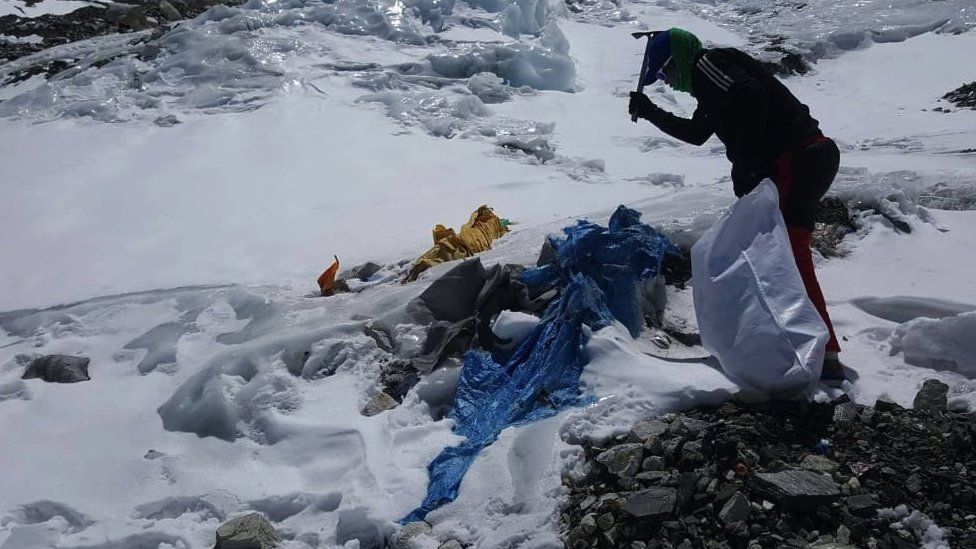
    A member of a clean-up campaign clearing rubbish left behind at Camp Three
    Image caption,Clean-up campaigns have led to the removal of some rubbish, but that is mostly in lower camps

    ‘Open toilet’

    “Waste remains a major issue, especially in higher up camps where you can’t reach,” says Chhiring Sherpa, Chief Executive Officer of the non-government organisation Sagarmatha Pollution Control Committee (SPCC).

    Although no official figure exists, his organisation estimates that there are around three tonnes of human excrement between camp one at the bottom of Everest and camp four, towards the summit.

    “Half of that is believed to be in South Col, also known as camp four,” Mr Chhiring says.

    Stephan Keck, an international mountain guide who also organises expeditions to Everest, said South Col has gained a reputation as an “open toilet”.

    At 7,906 metres (25,938 feet) high, South Col serves as the base before climbers attempt to reach the Everest and Lhotse summits. Here, the terrain is very windswept.

    “There is hardly any ice and snow, so you will see human stools all around,” Mr Keck says.

    This photograph taken on May 31, 2021 shows mountaineers lined up as they climb a slope during their ascend to summit Mount Everest (8,848.86-metre), in Nepal
    Image caption,The rising number of climbers means there has been a significant increase in waste on Everest

    Authorised by the Pasang Lhamu rural municipality, the SPCC is now procuring about 8,000 poo bags from the US, for an estimated 400 foreign climbers and 800 support staff for the upcoming climbing season that begins in March.

    These poo bags contain chemicals and powders that solidify human excrement and make it largely odourless.

    On average, a climber is thought to produce 250 grams of excrement per day. They usually spend about two weeks on the higher camps for the summit attempt.

    “With that as the basis, we plan to give them two bags, each of which they can use five to six times,” Mr Chhiring explains.

    “It certainly is a positive thing, and we will be happy to play our part to make this successful,” says Dambar Parajuli, president of the Expedition Operators Association of Nepal.

    He said his organisation had suggested that this should first be brought in as a pilot project on Everest and then replicated on other mountains too.

    Mingma Sherpa, the first Nepali to have climbed all 14 mountains above 8,000 metres, said use of such bags to manage human waste has been tried and tested on other mountains.

    “Mountaineers have been using such bags on Mount Denali (the highest peak in North America) and in the Antarctic as well, that is why we have been advocating for it,” says Mr Mingma, who is also an advisor to the Nepal Mountaineering Association.

    Mr Keck, the international mountain guide, echoed the same message, saying the idea will help to clean up the mountain.

    Ladders being collected at Camp Three of Mount Everest
    Image caption,Ropes and ladders left behind by climbers are collected and brought back, but human excrement remains on the mountains

    Nepal’s central government has announced several mountaineering rules in the past but there has been criticism that many of them have not been properly implemented.

    One of the main reasons is the absence of liaison officers on the ground. Government officials are supposed to be with expedition teams at the base camps but many of them have been criticised for not showing up.

    “The state has always been missing at base camps leading to all kinds of irregularities including people climbing our mountains without permits,” Mr Mingma, chairman of the Pasang Lhamu rural municipality, says.

    “This will all change now. We will run a contact office and make sure our new measures, including making climbers bring back their excrement, are implemented.”

  • The Rise of Blockchain Technology: Transforming Industries Beyond Cryptocurrency


    Blockchain technology, originally developed as the underlying infrastructure for cryptocurrencies like Bitcoin, has evolved into a revolutionary force reshaping various industries. In this post, we’ll explore the rise of blockchain technology, its core principles, and how it’s transforming sectors beyond cryptocurrency.

    At the heart of blockchain is decentralization. Unlike traditional centralized systems, blockchain operates on a distributed ledger, offering increased transparency, security, and resilience.

    Cryptocurrencies, particularly Bitcoin, pioneered the use of blockchain. Blockchain’s decentralized nature ensures secure and transparent transactions without the need for intermediaries like banks.

    Blockchain facilitates smart contracts, self-executing contracts with the terms directly written into code. This automation streamlines processes and reduces the need for intermediaries

    Blockchain improves supply chain transparency by providing a decentralized and immutable ledger, enabling stakeholders to trace the journey of products from manufacturing to delivery.

    Blockchain enhances identity management by offering a secure and verifiable way to manage digital identities, reducing the risk of identity theft and fraud.

    Blockchain has the potential to revolutionize voting systems by providing a secure and transparent platform for elections, minimizing the risk of fraud.

    Blockchain simplifies cross-border payments by reducing transaction times and costs, especially in regions where traditional banking infrastructure is limited.

    In real estate, blockchain ensures transparent and secure property transactions, reducing the complexities and risks associated with traditional methods.

    Blockchain can be used to timestamp and verify the ownership of intellectual property, providing a secure and immutable record of creative works.

    Blockchain enhances healthcare data security by providing a decentralized and tamper-proof system for storing and sharing patient information.

    Blockchain facilitates peer-to-peer energy trading, enabling users to buy and sell excess renewable energy directly, fostering a more sustainable and decentralized energy system.

    Blockchain ensures food safety by allowing consumers to trace the origin and journey of food products, reducing the risk of contamination and improving overall quality.

    Blockchain enables the tokenization of assets, turning physical assets like real estate or art into digital tokens, making them more accessible for a broader range of investors.

    Blockchain is revolutionizing the gaming industry by enabling secure ownership and transfer of in-game assets, as well as the creation of unique digital collectibles.

    Decentralized Finance, or DeFi, leverages blockchain to create financial services without traditional intermediaries, providing greater access to financial products and services.

    Blockchain’s cryptographic principles ensure a high level of privacy and security, making it a promising solution for safeguarding sensitive information.

    Efforts are underway to enhance blockchain interoperability, allowing different blockchain networks to communicate seamlessly, fostering a more connected and scalable ecosystem.

    Despite its potential, blockchain faces scalability challenges, with ongoing research and development focused on improving transaction speeds and efficiency.

    The regulatory landscape for blockchain is evolving, with governments worldwide considering frameworks to govern the technology while balancing innovation and security.

    As blockchain technology continues to mature, its future possibilities are vast, ranging from enhancing data privacy to reshaping entire industries, making it a transformative force in the technological landscape.

    Blockchain technology, with its foundational principles of decentralization, transparency, and security, is poised to redefine how industries operate. Its impact extends far beyond cryptocurrency, promising a future where trust and efficiency are paramount.