Elegir el lugar correcto para repostar puede suponer un ahorro significativo para los conductores en Villarrobledo y Logroño. Basándose en los datos del 6 de noviembre de 2024, se presentan las diferentes opciones disponibles:
**Villarrobledo**
*Gasolina 95 E5*
– BP, Avenida Reyes Católicos, 133: 1,519 €
– Repsol, Carretera Ossa de Montiel km. 21: 1,519 €
– Repsol, Carretera Nacional 310 km. 137,7: 1,519 €
– Cepsa, Avenida Reyes Católicos, 26: 1,634 €
– Cepsa, Autovía A-43 km. 390: 1,579 €
*Gasolina 98 E5*
– BP, Avenida Reyes Católicos, 133: 1,661 €
– Repsol, Carretera Ossa de Montiel km. 21: 1,629 €
– Repsol, Carretera Nacional 310 km. 137,7: 1,629 €
*Gasóleo A*
– BP, Avenida Reyes Católicos, 133: 1,449 €
– Repsol, Carretera Ossa de Montiel km. 21: 1,429 €
– Repsol, Carretera Nacional 310 km. 137,7: 1,429 €
– Cepsa, Avenida Reyes Católicos, 26: 1,519 €
– Cepsa, Autovía A-43 km. 390: 1,474 €
Este reporte diario proporciona a los conductores la información necesaria para tomar decisiones informadas sobre dónde repostar y ahorrar en sus desplazamientos cotidianos.
Elegir bien dónde repostar puede significar un ahorro considerable para los automovilistas de Villarrobledo y Logroño. En Villarrobledo, el precio más económico para la gasolina 95 lo ofrece Combustibles Fiel, S.L. en Calle Arquímedes, 62 a 1,379 €. Este mismo punto también ofrece uno de los precios más bajos para el diésel A, a 1,339 €. Aunque no todos los establecimientos ofrecen gasolina 98, Carrefour en Avenida Reyes Católicos proporciona esta opción a 1,589 €.
En Logroño, los precios de gasolina 95 parten desde 1,559 €, encontrando este precio en varios puntos, como la AU AP-68, 136,2 bajo el rótulo de Repsol. Para la gasolina 98, la opción más económica es en la misma ubicación, AU AP-68, a 1,559 €. En cuanto al diésel A, el precio más accesible es de 1,267 €, ofrecido por Petroprix en Calle Circunde, 13.
Estos precios, actualizados el 5 de noviembre de 2024, son cruciales para quienes desean maximizar el rendimiento de sus gastos en combustible, asegurando el mejor uso de sus recursos al desplazarse por estas localidades.
Cars are more than just machines that transport us from one place to another; they are integral to the fabric of modern society. The advent of the automobile has revolutionized the way we live, work, and interact, shaping cities, economies, and lifestyles. This article explores the profound impact cars have had on various aspects of our lives and how they continue to influence the future.
Urbanization and Infrastructure
The widespread adoption of cars in the 20th century fundamentally altered urban landscapes. Cities expanded outward, leading to the development of suburbs and the rise of commuter culture. Highways, bridges, and tunnels were constructed to accommodate increasing traffic, facilitating faster and more efficient travel. The car-centric design of many cities resulted in sprawling metropolitan areas, influencing urban planning and architecture.
Economic Impact
The automotive industry is a cornerstone of the global economy. It generates millions of jobs in manufacturing, sales, maintenance, and supply chains. The production and sale of cars drive significant economic activity, contributing to GDP growth. Moreover, related industries such as oil and gas, insurance, and finance are deeply intertwined with the automotive sector, underscoring its economic significance.
Social Mobility and Lifestyle Changes
Cars have transformed personal mobility, providing individuals with unprecedented freedom and flexibility. They have made it possible for people to live farther from their workplaces, giving rise to the concept of suburbs and enabling a greater balance between urban and rural living. The car has become a symbol of independence and personal freedom, influencing social dynamics and lifestyles.
Environmental Impact
While cars have brought numerous benefits, they have also contributed to environmental challenges. The widespread use of internal combustion engines has led to significant air pollution and greenhouse gas emissions, contributing to climate change. Urban areas often suffer from traffic congestion and poor air quality, prompting a push for cleaner, more sustainable transportation solutions.
Technological Innovation
The automotive industry has been a driving force behind technological advancements. Innovations in materials, engineering, and manufacturing have led to safer, more efficient vehicles. Modern cars are equipped with advanced features such as GPS navigation, adaptive cruise control, and automated parking systems, enhancing the driving experience. The ongoing development of electric and autonomous vehicles promises to further revolutionize transportation.
Cultural Influence
Cars hold a prominent place in global culture. They are featured in countless movies, songs, and artworks, symbolizing freedom, adventure, and status. Car culture is celebrated through events such as auto shows, racing, and car clubs, fostering a sense of community among enthusiasts. Iconic models like the Ford Mustang, Volkswagen Beetle, and Ferrari have become cultural icons, representing different eras and lifestyles.
The Future of Cars
As we look to the future, the role of cars in society continues to evolve. The transition to electric vehicles (EVs) is gaining momentum, driven by advancements in battery technology and growing environmental awareness. Autonomous vehicles (AVs) are poised to transform transportation, offering the potential for increased safety, efficiency, and accessibility. These changes will require significant investment in infrastructure and regulatory frameworks but promise to reshape our cities and lifestyles once again.
Conclusion
Cars have played a pivotal role in shaping modern society, influencing urban development, economic growth, and cultural trends. While they have brought numerous benefits, they also pose challenges that need to be addressed to ensure a sustainable future. As technology advances, the automotive industry will continue to innovate, driving forward new possibilities for personal mobility and societal progress. The journey of the automobile is far from over, and its impact on our lives will remain profound and enduring.
Cars, a staple of modern transportation, have undergone tremendous evolution since their inception. From the rudimentary horseless carriages of the late 19th century to today’s sophisticated electric and autonomous vehicles, the journey of automotive development reflects technological advances and changing societal needs.
Early Beginnings: The Horseless Carriage
The concept of the automobile dates back to the late 1800s. Early inventors like Karl Benz and Henry Ford played pivotal roles in transforming the horseless carriage from a novel idea into a viable means of transportation. Benz’s Patent-Motorwagen, introduced in 1886, is widely regarded as the first true automobile, equipped with an internal combustion engine. Meanwhile, Ford’s introduction of the Model T in 1908 revolutionized the industry by making cars affordable and accessible to the masses through assembly line production.
The Rise of the Internal Combustion Engine
Throughout the early 20th century, the internal combustion engine (ICE) became the dominant power source for cars. Advances in engineering led to more powerful, reliable, and efficient engines. This era also saw the birth of iconic brands like General Motors, Ford, and Chrysler, which shaped the automotive landscape in the United States and beyond.
The Post-War Boom
The end of World War II marked a period of unprecedented growth and innovation in the automotive industry. The 1950s and 1960s saw the introduction of many classic models, characterized by bold designs, increased horsepower, and enhanced comfort. During this time, cars became symbols of status and freedom, deeply embedding themselves in popular culture.
The Oil Crisis and Environmental Awareness
The 1970s oil crisis brought significant challenges to the automotive industry. Fuel efficiency became a critical concern, leading to the development of smaller, more economical cars. This period also marked the beginning of environmental awareness, with regulations aimed at reducing emissions and improving air quality. Innovations such as catalytic converters and unleaded gasoline emerged as responses to these new environmental standards.
The Digital Revolution
The late 20th and early 21st centuries witnessed the digital revolution’s impact on automobiles. Electronic control units (ECUs), advanced safety systems, and in-car entertainment transformed vehicles into high-tech machines. The integration of GPS, airbags, anti-lock braking systems (ABS), and electronic stability control (ESC) improved safety and driving experience.
The Emergence of Electric Vehicles (EVs)
In recent years, the automotive industry has shifted towards sustainability and reduced carbon footprints, spurred by advancements in battery technology and increasing environmental concerns. Electric vehicles (EVs), once considered impractical, have become a viable alternative to traditional ICE vehicles. Pioneers like Tesla have led this charge, proving that EVs can be powerful, efficient, and desirable. Governments worldwide are also supporting this transition through incentives and stricter emission regulations.
Autonomous Vehicles: The Future of Mobility
Autonomous vehicles (AVs) represent the next frontier in automotive innovation. Leveraging artificial intelligence (AI), sensors, and machine learning, AVs promise to revolutionize transportation by enhancing safety, reducing traffic congestion, and improving mobility for all, including those unable to drive. Companies like Waymo, Uber, and major automakers are investing heavily in developing self-driving technology, with pilot programs already underway in several cities.
Challenges and Opportunities
While the future of cars is promising, several challenges remain. The transition to electric and autonomous vehicles requires substantial investment in infrastructure, such as charging stations and smart roads. Additionally, issues like cybersecurity, data privacy, and regulatory hurdles must be addressed to ensure the safe and smooth integration of these technologies.
Conclusion
The evolution of cars from simple horseless carriages to sophisticated electric and autonomous vehicles highlights the remarkable progress of human ingenuity and technology. As we move forward, the automotive industry will continue to innovate, driven by the twin goals of enhancing mobility and addressing environmental concerns. The future of transportation promises to be as exciting and transformative as its past, heralding a new era of automotive excellence.
Playing cards have been a staple of human entertainment for centuries, captivating individuals across cultures and generations. From casual games among friends to high-stakes gambling in opulent casinos, the allure of cards knows no bounds. However, beyond their entertainment value, playing cards hold a rich history and cultural significance that stretches back through the annals of time.
The Origin of Playing Cards: The precise origins of playing cards remain shrouded in mystery, with various theories attributing their invention to different civilizations. One prevailing theory suggests that playing cards originated in China during the Tang Dynasty (618–907 AD), evolving from paper dominoes. These early cards, adorned with intricate designs and symbols, spread along trade routes and reached Europe by the 14th century. Another theory proposes that playing cards emerged independently in different parts of the world, including India and Egypt.
Evolution of Design and Symbolism: Over the centuries, playing cards have undergone numerous transformations in design, reflecting the cultural and artistic trends of their time. From the ornate court cards of the Renaissance to the minimalist designs of modern decks, the visual appeal of playing cards has continuously evolved. Moreover, the symbols and motifs depicted on cards—such as hearts, diamonds, spades, and clubs—have transcended geographical boundaries, becoming universally recognizable icons.
Social and Cultural Significance: Beyond their role in games and gambling, playing cards have permeated various aspects of society, leaving an indelible mark on art, literature, and even psychology. Artists have drawn inspiration from the intricate designs of playing cards, incorporating them into paintings, sculptures, and other forms of visual art. Likewise, writers have woven tales of intrigue and deception around the symbolism of cards, immortalizing them in works of fiction.
Moreover, psychologists have studied the psychological dynamics inherent in card games, exploring concepts such as risk-taking behavior, decision-making, and social interaction. Whether played in a casual setting or a competitive environment, card games offer a microcosm of human behavior, revealing insights into our cognitive processes and social dynamics.
The Digital Age and Beyond: In recent decades, the advent of digital technology has ushered in a new era for playing cards, with virtual versions of classic games proliferating across online platforms. While traditionalists may lament the waning popularity of physical decks, the digitalization of playing cards has introduced them to a global audience, transcending geographical boundaries and time zones.
Furthermore, the future of playing cards holds endless possibilities, as innovators continue to explore new ways to integrate technology and enhance the gaming experience. Whether through augmented reality, blockchain technology, or other cutting-edge advancements, playing cards are poised to remain a timeless form of entertainment for generations to come.
Conclusion: In a world of ever-changing trends and fads, playing cards stand as a testament to the enduring power of human creativity and imagination. From their enigmatic origins to their widespread influence on culture and society, playing cards have woven themselves into the fabric of human history. As we shuffle, deal, and play our way through life, let us not forget the timeless appeal and enduring legacy of these humble yet extraordinary artifacts.
India’s space agency has released images of the far side of the Moon as its third lunar mission attempts to locate a safe landing spot near the little-explored south pole.
The pictures have been taken by Vikram, Chandrayaan-3’s lander, which began the last phase of its mission on Thursday.
Vikram, which carries a rover in its belly, is due to land on 23 August.
The photos come a day after Russia’s Luna-25 spacecraft crashed into the Moon after spinning out of control.
The craft – Russia’s first Moon mission in nearly 50 years – was due to be the first ever to land on the south pole, but failed after encountering problems as it moved into its pre-landing orbit.
On Monday morning, the Indian Space Research Organisation (Isro) said the lander from Chandrayaan-3, which is due to touch down on Wednesday at 18:04 India time (12:34 GMT), has been mapping the landing area and taking images with its “hazard detection and avoidance” camera.
Isro added that the black-and-white images sent by this camera will assist them “in locating a safe landing area – without boulders or deep trenches”.
The lunar far side is the side that faces away from the Earth and is sometimes also called “the dark side of the Moon” because so little is known about it. Scientists say landing there can be a tricky affair.
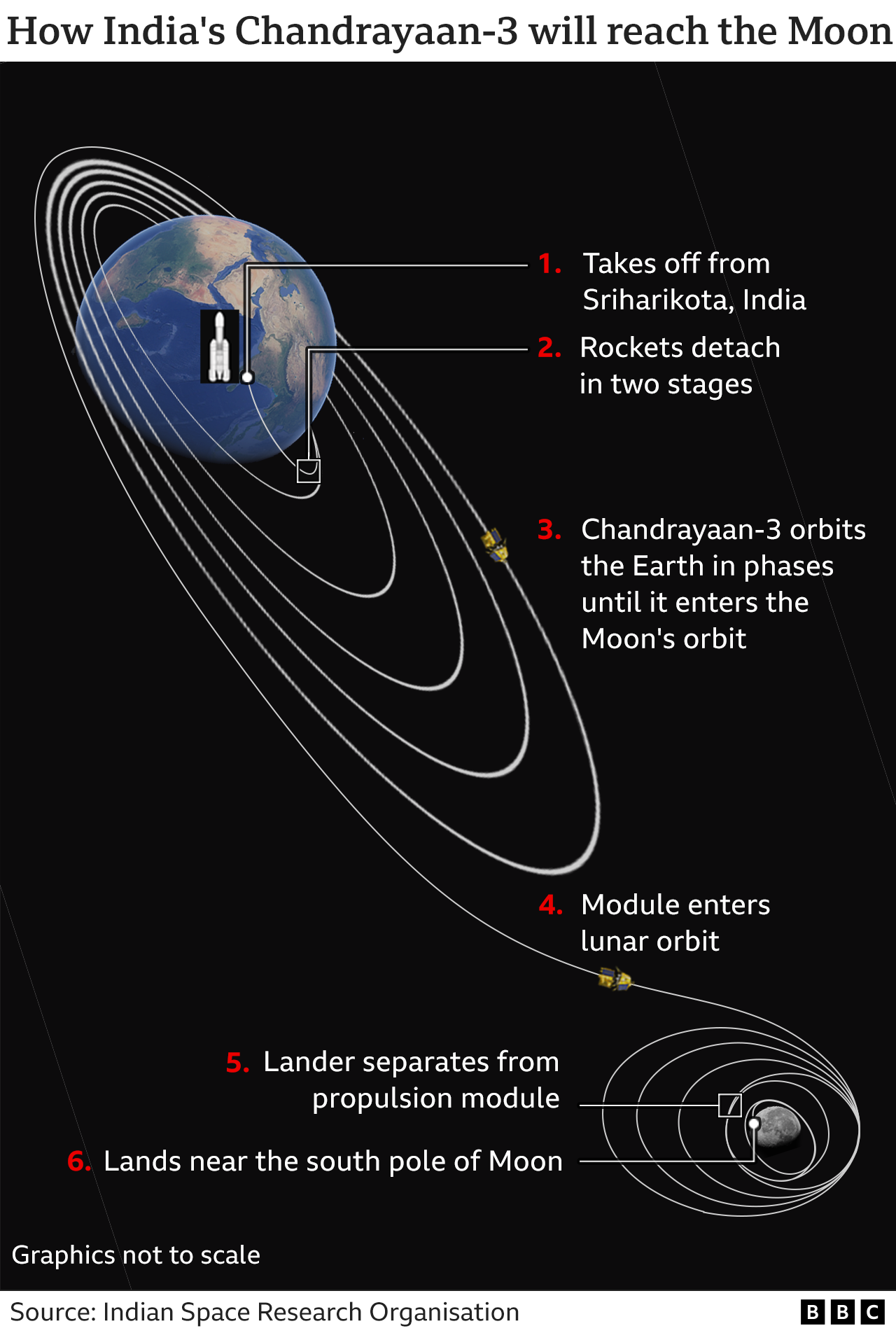
Isro said on Sunday that the lander module had been successfully lowered into an orbit closer to the Moon (of 25km by 134km) and is now waiting for the lunar Sun-rise to land.
If Chandrayaan-3 is successful, India will be first to land near the lunar south pole. It will also be only the fourth country to achieve a soft landing on the Moon after the US, the former Soviet Union and China.
The third in India’s programme of lunar exploration, Chandrayaan-3 is expected to build on the success of its earlier Moon missions.
It comes 15 years after the country’s first Moon mission in 2008, which discovered the presence of water molecules on the parched lunar surface and established that the Moon has an atmosphere during daytime.
Chandrayaan-2 – which also comprised an orbiter, a lander and a rover – was launched in July 2019 but it was only partially successful. Its orbiter continues to circle and study the Moon even today, but the lander-rover failed to make a soft landing and crashed during touchdown.
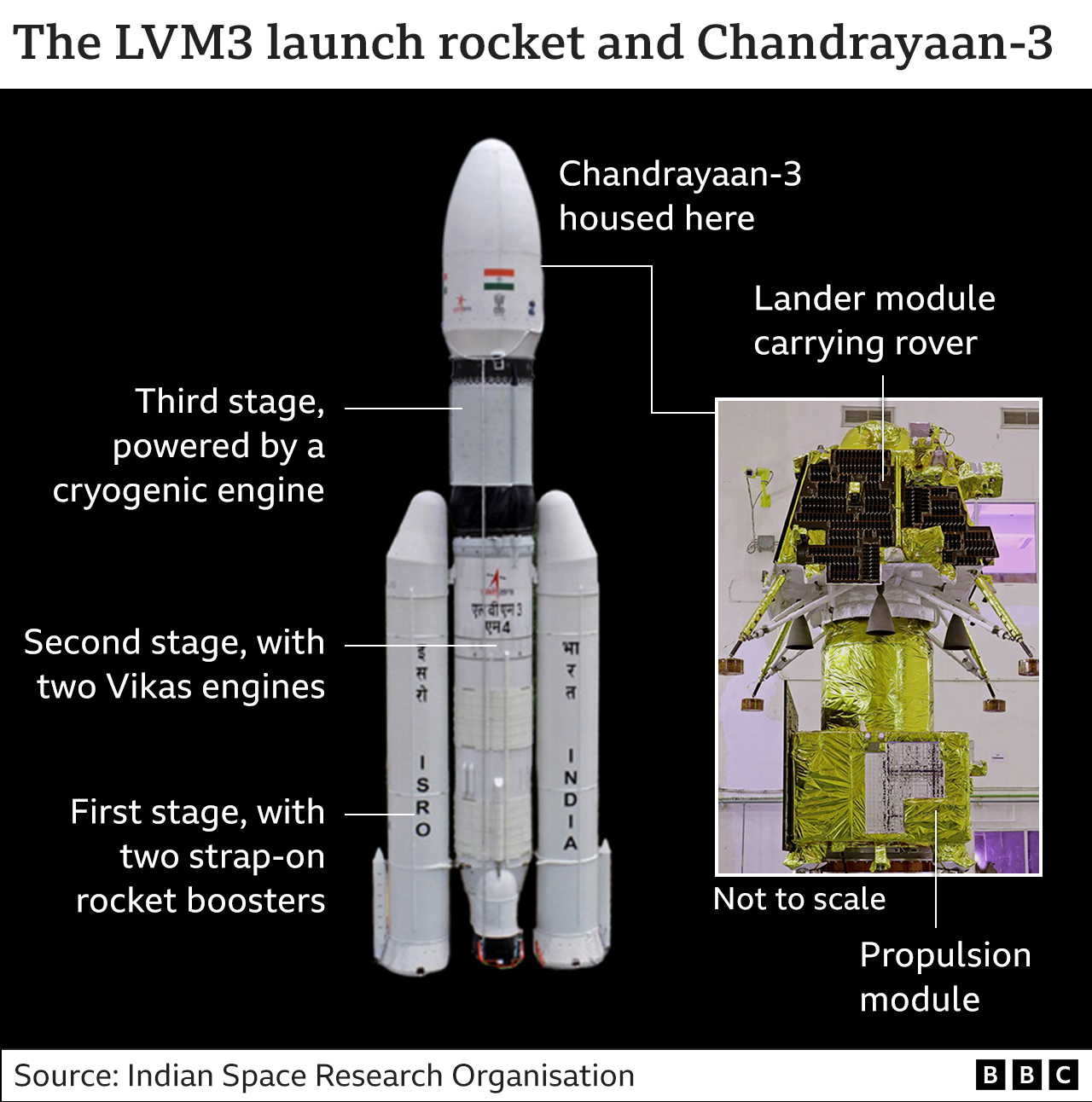
Isro chief Sreedhara Panicker Somanath has said that the space agency had carefully studied the data from its crash and carried out simulation exercises to fix the glitches in Chandrayaan-3, which weighs 3,900kg and cost 6.1bn rupees ($75m; £58m). The lander module weighs about 1,500kg, including the 26kg-rover Pragyaan.
The south pole of the Moon is still largely unexplored – the surface area that remains in shadow there is huge, and scientists say it means there is a possibility of water in areas that are permanently shadowed.
One of the major goals of Chandrayaan-3 is to hunt for water ice, which scientists say could support human habitation on the Moon in future. It could also be used for supplying propellant for spacecraft headed to Mars and other distant destinations.
This year’s Super Bowl was watched by an average of 123.4 million people in the US, making it the most watched broadcast since the 1969 Moon landing.
Preliminary US TV ratings put Sunday’s game just behind Apollo 11’s historic landing, which was seen by an estimated 125 to 150 million people.
Kansas City Chiefs beat the San Francisco 49ers 25-22 in overtime.
Taylor Swift’s highly anticipated attendance to watch boyfriend Travis Kelce may have boosted the figures.
There was much speculation in the run-up to the event about whether Swift would make it back from Japan, where she had been performing on tour.
According to Variety, there is some debate over how much she affected audience numbers, but consumer research firm Numerator concluded from a flash poll that 20% of Super Bowl viewers were rooting for the Chiefs because of the singer’s relationship with Kelce.
The cameras were certainly enjoying the Swift factor, including shots of the star entering the arena, hanging out with actress Blake Lively and rapper Ice Spice, and kissing Kelce after the match as they celebrated the win.
Of this year’s viewers, 112 million of the 123.4 million average watched the game on CBS, with the rest tuning into Paramount+, Nickelodeon, Univision, CBS Sports and NFL digital channels.
According to media analysts Nielsen, a record 202.4 million people watched at least part of the game.
This year’s figures may have also been helped by the fact Nielsen has changed the way it counts people watching out of their own homes – for example with friends or family, or in bars.
Last year’s Super Bowl game between the Chiefs and the Philadelphia Eagles was watched by 115.1 million viewers.
Image caption,Usher topped off the weekend by marrying his girlfriend Jennifer
The fact the Chiefs were defending their championship title plus Usher performing the half-time show were also big draws this year.
The pop star’s guests included Alicia Keys, H.E.R., Will.i.am, Lil John, Ludacris and Jermaine Dupri.
Usher continued the celebrations later by getting married to his long-term partner Jennifer Goicoechea in Las Vegas, where the Super Bowl was held.
The couple got hitched at Vegas Weddings’ Terrace Gazebo, an outdoor wedding chapel that seats 30 guests, according to People.
“We can confirm that Usher and Jennifer Goicoechea took the next step in their relationship and did get married on Sunday night in Las Vegas surrounded by close friends and family,” a representative for the singer told the publication.
“They both look forward to continuing to raise their children together surrounded by love and thank everyone for the well wishes.”
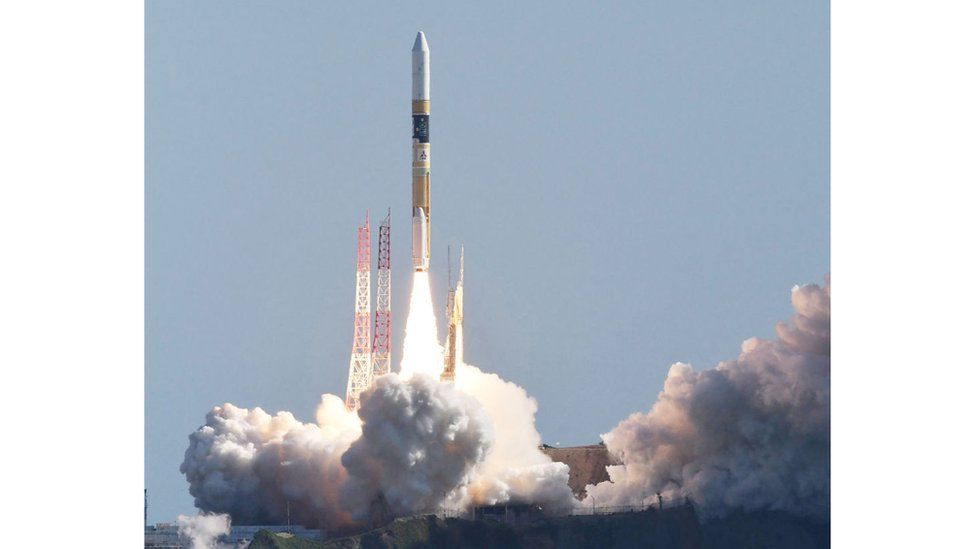
Japan’s space agency Jaxa has made its first soft Moon landing with an unmanned spacecraft.
Jaxa attempted the nail-biting 20 minute landing at 15:30 GMT on Friday and live streamed the event on YouTube.
Only half of all attempts to land on the Moon have ever succeeded.
The live stream appeared to show the spacecraft, named Slim (Smart Lander for Investigating Moon), successfully touching down on the Moon, but there was a wait of more than an hour before this was confirmed.
Slim also released two tiny robotic probes to investigate the Moon’s surface.
Texan company Intuitive Machines (IM) will attempt to put a spacecraft on the Moon in the coming hours.
If the firm succeeds, it will be the first ever commercial venture to achieve the feat.
It would also represent the first American soft landing on the lunar surface since the Apollo era just over half a century ago.
IM has been contracted by the US space agency (Nasa) to carry scientific instruments to the Moon’s south pole.
The targeted landing site is a cratered terrain next to a 5km-high mountain complex known as Malapert. The region is one of the locations on Nasa’s shortlist of places to send astronauts later this decade as part of its Artemis programme.
The instrumentation should give planners some fresh insights on what surface conditions are like.
Controllers at Intuitive Machines are aiming for a touchdown around 23:24 GMT, although the company has shifted this time back and forth in recent hours.
“The six Nasa payloads and six commercial payloads expect to operate on the lunar surface for seven days before the Sun sets on our landing site at Malapert A Crater on the south pole of the Moon, rendering the IM-1 mission complete. During this time, we will be performing some amazing experiments and technology demonstrations,” said Trent Martin, the company’s vice president of space systems.
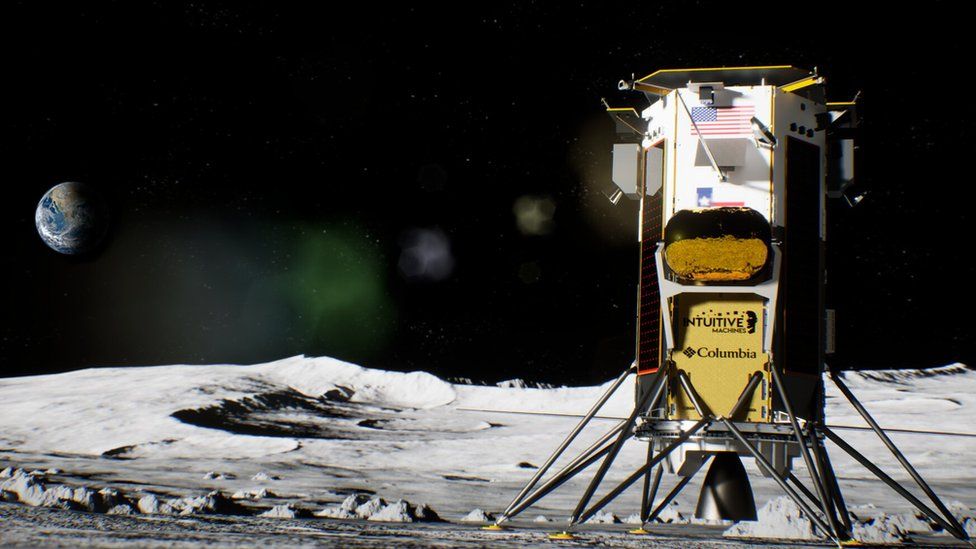
Image caption,Artwork: A successful soft landing would be a first for a private company
IM’s effort follows that of another private concern, Pittsburgh-based Astrobotic, which set off for the Moon in early January but couldn’t even attempt a landing because of technical problems.
The Japanese space agency (Jaxa) had better fortune at the end of the month, reaching the surface safely on 19 January, although it lost several days of operations because it landed awkwardly, leaving its solar array pointing away from the Sun.
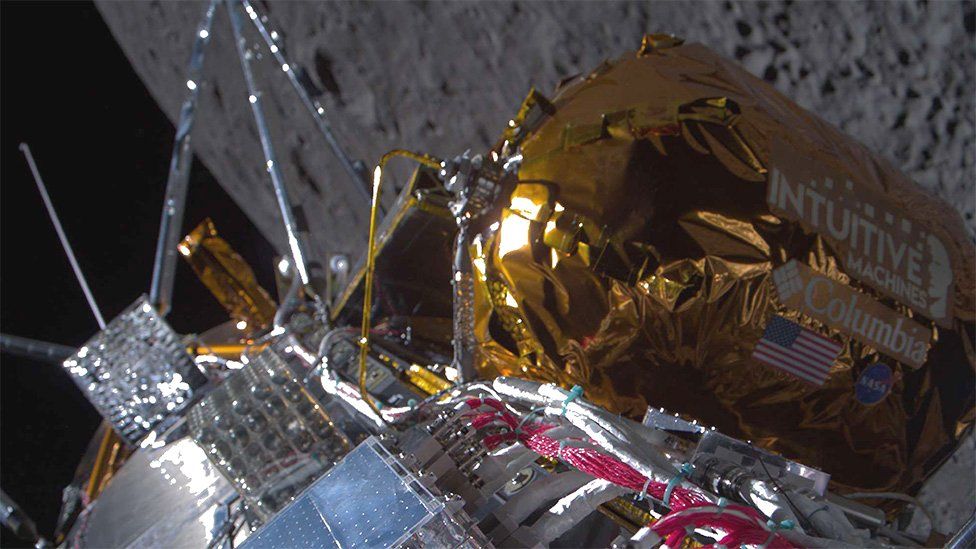
IM’s 675kg Odysseus lander is about the size of an old British telephone box. It was despatched from Earth on 15 February and was captured into orbit around the Moon on Wednesday this week.
Controllers will monitor the spacecraft’s descent at the company HQ in Houston but it will be Odysseus itself that will be taking the key decisions on approach.
Initially at 100km altitude, Odysseus will use its guidance system to bring itself to a point roughly 30km above the designated landing site, and then drop straight down. The big engine on board is expected to slow the descent to just one-metre-per-second at the moment of landing.
If the mission gets down safely it will be the southernmost landing yet executed. The Indian space agency (Isro) currently holds this record, thanks to its historic Chandrayaan-3 Vikram lander, which settled on the lunar terrain in August last year at 69 degrees South.
IM’s target is at 80 degrees South, a mere 300km from the south pole proper.
Image caption,Odysseus captured this image of the 50km-wide Bel’kovich K crater after orbit insertion
The mission is part of Nasa’s Commercial Lunar Payload Services (CLPS) programme, in which the agency is paying various private American companies for transport services to the Moon – in this particular case, with a fee of $118M (£93m).
“With commercial industry comes a competitive environment, which means that our investment up front ultimately gets far more for far less,” explained Nasa’s CLPS project scientist Susan Lederer.
“Instead of one (Nasa) mission in a decade, it allows for more like 10 commercial missions to the Moon in a decade; instead of four or five instruments in that one decade, it’s more like four to five dozen instruments.”
Nasa’s six instruments are joined on Odysseus by payloads from six other IM customers.
These include a student camera system from Embry-Riddle Aeronautical University which will be deployed from Odysseus when it is still 30m above the lunar surface. The camera will try to take selfie images as the spacecraft touches down.
The American artist Jeff Koons has also attached a box to the side of the lander that contains 125 small stainless steel balls to represent the Moon’s different phases through a month.
And there’ll even be a telescope from the International Lunar Observatory Association on board, taking pictures of the Milky Way Galaxy. The Moon is an ideal place to do astronomical research because it doesn’t suffer from some of the confounding effects experienced on Earth, such as a blurry atmosphere and radio interference.
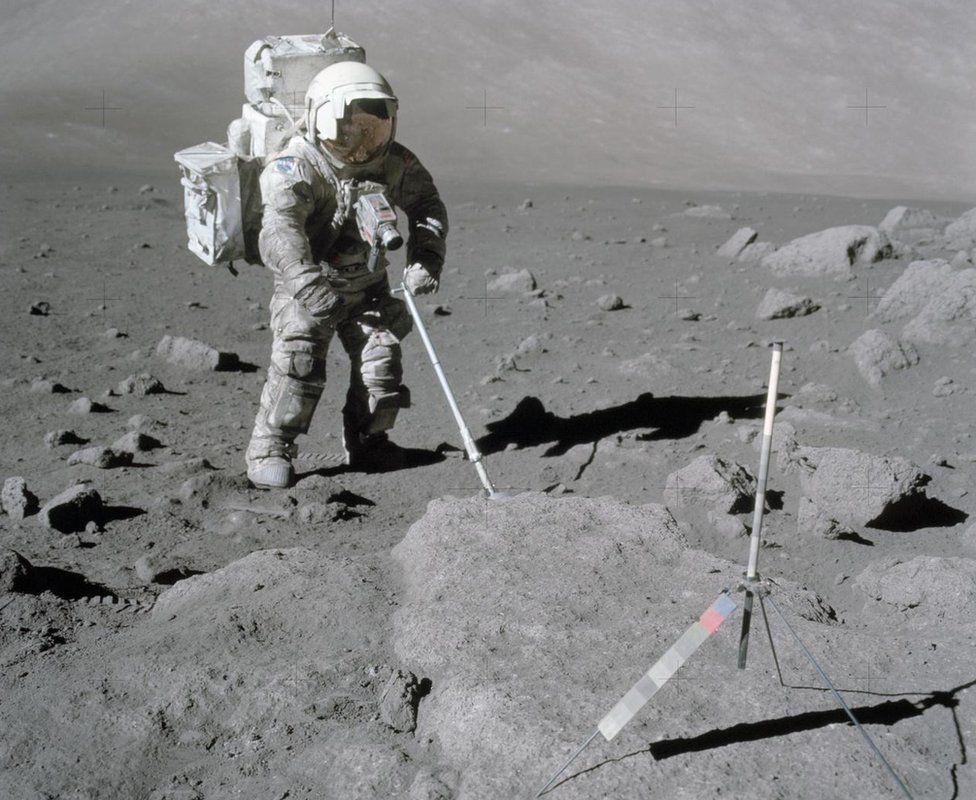
Image caption,The Apollo astronauts were in a constant battle with lunar dust
Nasa’s payloads will concentrate on getting information that will be useful to future human exploration. There are novel technologies on Odysseus to aid precise navigation and to know exactly how much propellant is available to a craft’s thrusters.
There will also be investigations of lunar dust, which the Apollo astronauts found to be a serious nuisance, scratching and clogging their equipment.
Historically, about half of all soft landings on the Moon have succeeded.
This is true even in the modern era, in this century, which started with China’s Chang’e-3 mission in 2013. It worked, but of the 10 attempts since, six ended in failure.
An American company has made history by becoming the first commercial outfit to put a spacecraft on the Moon.
Houston-based Intuitive Machines landed its Odysseus robot near the lunar south pole.
It took some minutes for controllers to establish that the craft was down, but eventually a signal was received.
“What we can confirm, without a doubt, is our equipment is on the surface of the Moon and we are transmitting,” flight director Tim Crain announced.
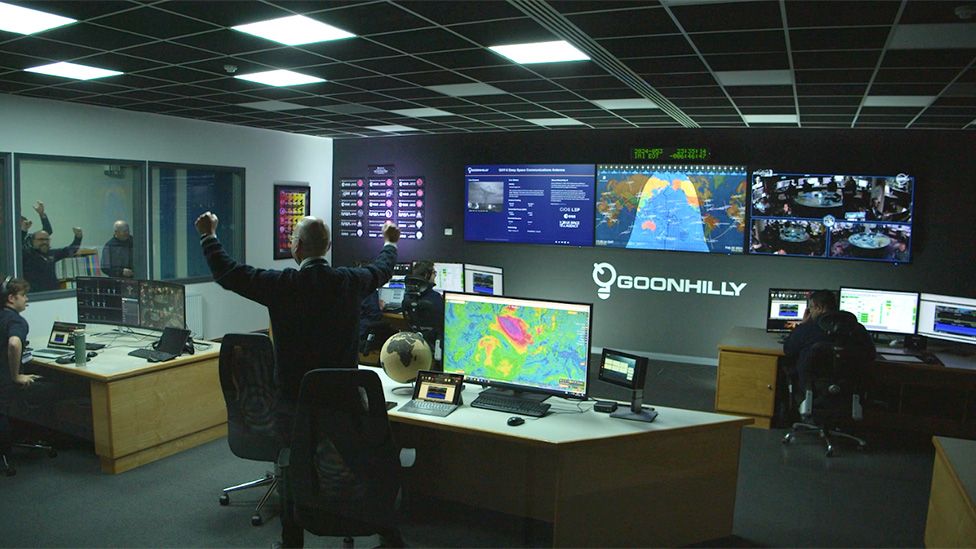
Staff at the company cheered and clapped at the news.
It was an important moment, not just for the commercial exploitation of space but for the US space programme in general.
Intuitive Machines has broken the United States’ half-century absence from the Moon’s surface. You have to go back to the last Apollo mission in 1972 for an occasion when American hardware nestled down gently in the lunar soil.
Image caption,Odysseus first went into orbit before making its descent
The US space agency Nasa had purchased room on Odysseus for six scientific instruments, and its administrator Bill Nelson was quick to add his congratulations to Intuitive Machines for a mission he described as a “triumph”.
“The US has returned to the Moon,” he said. “Today, for the first time in the history of humanity, a commercial company – an American company – launched and led the voyage up there. And today is the day that shows the power and promise of Nasa’s commercial partnerships.”
Image caption,Celebrations too at Goonhilly Ltd in the UK which is helping to relay communications
Controllers had to deal with an almost mission-stopping technical problem even before the descent began.
Odysseus’ ranging lasers, which were supposed to calculate the craft’s altitude and velocity, weren’t working properly.
Fortunately, there were some experimental lasers from Nasa on board, and engineers were able to patch these across to the navigation computers.
Odysseus touched down at 23:23 GMT. At first, there was no signal at all from the robot. There were plenty of nerves as the minutes ticked by, but eventually a communications link was made, albeit a faint one.
This led to some concerns about the status of the lander. Within a couple of hours, however, Intuitive Machines was reporting that Odysseus was standing upright and sending back data, including pictures.
Image caption,Artwork: It took a few minutes to establish communications with the lander
The targeted landing site was a cratered terrain next to a 5km-high mountain complex known as Malapert. It’s the southernmost point on the Moon ever visited by a spacecraft, at 80 degrees South.
It’s on the shortlist of locations where Nasa is considering sending astronauts later this decade as part of its Artemis programme.
There are some deep craters in this region that never see any sunlight – they’re permanently in shadow – and scientists think frozen water could be inside them.
“The ice is really important because if we can actually take advantage of that ice on the surface of the Moon, that’s less materials we have to bring with us,” explained Lori Glaze, Nasa’s director of planetary science.
“We could use that ice to convert it to water – drinkable drinking water – and we can extract oxygen and hydrogen for fuel and for breathing for the astronauts. So it really helps us in human exploration.”
Image caption,The Apollo astronauts were in a constant battle with lunar dust
Nasa’s six payloads on board Odysseus are a mix of technology demonstration and science.
A key investigation will be one looking at the behaviour of lunar dust, which the Apollo astronauts found to be a serious nuisance, scratching and clogging their equipment.
The agency’s scientists want to understand better how the dust is kicked up by landing craft to hang just above the surface before then settling back down.
The six commercial payloads on board include a student camera system from Embry-Riddle Aeronautical University, which should have been deployed from Odysseus when it was still 30m above the lunar surface.
This system was designed to take selfie images as the robot set itself down.
American artist Jeff Koons has also attached a box to the side of the lander that contains 125 small stainless steel balls to represent the Moon’s different phases through a month.
Prior to Intuitive Machines’ success, only government space agencies had put spacecraft down softly on the Moon – the US, the Soviet Union, China, India and Japan.
In January, another American company, Astrobotic, had a go. Its Peregrine lander developed technical problems en route to the Moon and gave up the opportunity of a touchdown. The robot was brought back to burn up in Earth’s atmosphere.