Tag: Travel-Explore

  • Mount Everest: Climbers will need to bring poo back to base camp

    By Navin Singh Khadka

    Environment correspondent, BBC World Service

    People climbing Mount Everest will now have to clear up their own poo and bring it back to base camp to be disposed of, authorities have said.

    “Our mountains have begun to stink,” Mingma Sherpa, chairman of Pasang Lhamu rural municipality, told the BBC.

    The municipality, which covers most of the Everest region, has introduced the new rule as part of wider measures being implemented.

    Due to extreme temperatures, excrement left on Everest does not fully degrade.

    “We are getting complaints that human stools are visible on rocks and some climbers are falling sick. This is not acceptable and erodes our image,” Mr Mingma adds.

    Climbers attempting Mount Everest, the world’s tallest peak, and nearby Mount Lhotse will be ordered to buy so-called poo bags at base camp, which will be “checked upon their return”.

    Where do you poo up a mountain?

    During climbing season mountaineers spend most of their time at base camp acclimatising to the altitude, where separate tents are erected as toilets, with barrels underneath collecting the excrement.

    But once they begin their treacherous journey things get more difficult.

    Most climbers and support staff tend to dig a hole but the higher you go up the mountain, some locations have less snow, so you have to go to the toilet out in the open.

    Very few people bring their excrement back in biodegradable bags when climbing Mount Everest’s summit, which can take weeks.

    Rubbish remains a huge issue on Everest and other mountains in the region, although there has been an increasing number of clean-up campaigns, including an annual one led by the Nepali Army.
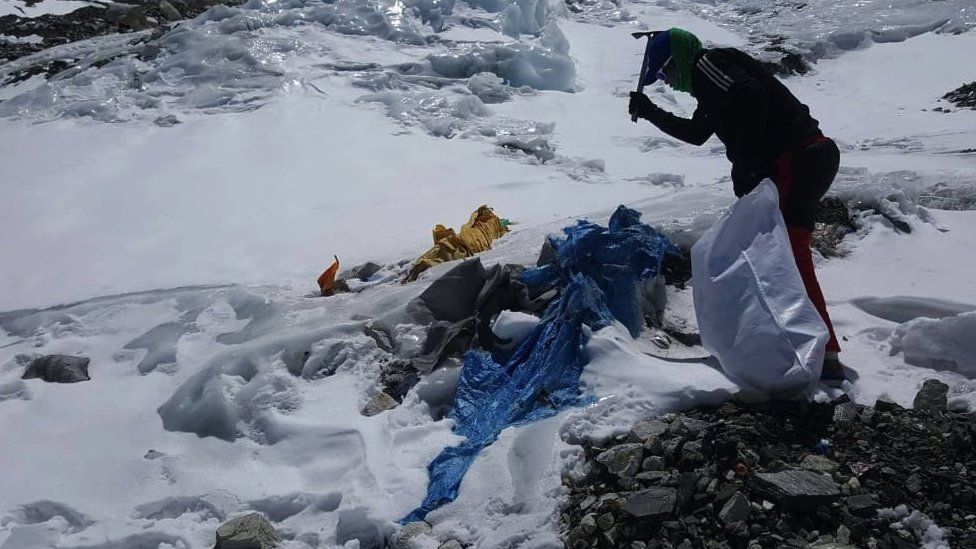
    A member of a clean-up campaign clearing rubbish left behind at Camp Three
    Image caption,Clean-up campaigns have led to the removal of some rubbish, but that is mostly in lower camps

    ‘Open toilet’

    “Waste remains a major issue, especially in higher up camps where you can’t reach,” says Chhiring Sherpa, Chief Executive Officer of the non-government organisation Sagarmatha Pollution Control Committee (SPCC).

    Although no official figure exists, his organisation estimates that there are around three tonnes of human excrement between camp one at the bottom of Everest and camp four, towards the summit.

    “Half of that is believed to be in South Col, also known as camp four,” Mr Chhiring says.

    Stephan Keck, an international mountain guide who also organises expeditions to Everest, said South Col has gained a reputation as an “open toilet”.

    At 7,906 metres (25,938 feet) high, South Col serves as the base before climbers attempt to reach the Everest and Lhotse summits. Here, the terrain is very windswept.

    “There is hardly any ice and snow, so you will see human stools all around,” Mr Keck says.
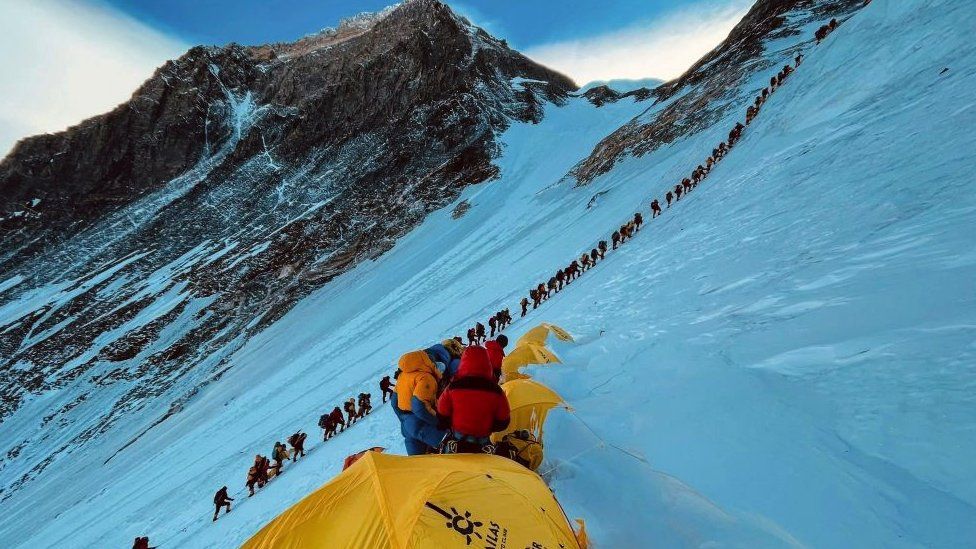
    This photograph taken on May 31, 2021 shows mountaineers lined up as they climb a slope during their ascend to summit Mount Everest (8,848.86-metre), in Nepal
    Image caption,The rising number of climbers means there has been a significant increase in waste on Everest

    Authorised by the Pasang Lhamu rural municipality, the SPCC is now procuring about 8,000 poo bags from the US, for an estimated 400 foreign climbers and 800 support staff for the upcoming climbing season that begins in March.

    These poo bags contain chemicals and powders that solidify human excrement and make it largely odourless.

    On average, a climber is thought to produce 250 grams of excrement per day. They usually spend about two weeks on the higher camps for the summit attempt.

    “With that as the basis, we plan to give them two bags, each of which they can use five to six times,” Mr Chhiring explains.

    “It certainly is a positive thing, and we will be happy to play our part to make this successful,” says Dambar Parajuli, president of the Expedition Operators Association of Nepal.

    He said his organisation had suggested that this should first be brought in as a pilot project on Everest and then replicated on other mountains too.

    Mingma Sherpa, the first Nepali to have climbed all 14 mountains above 8,000 metres, said use of such bags to manage human waste has been tried and tested on other mountains.

    “Mountaineers have been using such bags on Mount Denali (the highest peak in North America) and in the Antarctic as well, that is why we have been advocating for it,” says Mr Mingma, who is also an advisor to the Nepal Mountaineering Association.

    Mr Keck, the international mountain guide, echoed the same message, saying the idea will help to clean up the mountain.

    Ladders being collected at Camp Three of Mount Everest
    Image caption,Ropes and ladders left behind by climbers are collected and brought back, but human excrement remains on the mountains

    Nepal’s central government has announced several mountaineering rules in the past but there has been criticism that many of them have not been properly implemented.

    One of the main reasons is the absence of liaison officers on the ground. Government officials are supposed to be with expedition teams at the base camps but many of them have been criticised for not showing up.

    “The state has always been missing at base camps leading to all kinds of irregularities including people climbing our mountains without permits,” Mr Mingma, chairman of the Pasang Lhamu rural municipality, says.

    “This will all change now. We will run a contact office and make sure our new measures, including making climbers bring back their excrement, are implemented.”

  • Exploring the World Solo: The Transformative Power of Solo Travel

    Solo travel is a journey of self-discovery, an opportunity to explore the world on your terms, and a transformative experience that can shape your outlook on life. In this post, we’ll delve into the world of solo travel, its rewards, challenges, and the profound impact it can have on those who embrace it.

    Solo travel empowers individuals to make independent decisions, plan their adventures, and navigate the world with self-reliance.

    Traveling alone often leads to personal growth, pushing you out of your comfort zone and allowing you to develop valuable life skills.

    When you travel solo, you have the freedom to choose your destinations, activities, and pace without compromising on others’ preferences.

    Solo travelers often have more opportunities for cultural immersion as they connect with locals and communities more easily.

    Solo travel offers ample time for self-reflection, introspection, and a deeper understanding of your own aspirations and values.

    Traveling alone encourages you to reach out and meet new people, fostering genuine connections and friendships on the road.

    Solo travelers often develop a deeper sense of empathy and understanding for different cultures, perspectives, and ways of life.

    Navigating the complexities of travel solo hones your problem-solving skills, from language barriers to logistical challenges.

    Solo travelers become more resilient and adaptable, learning to embrace change and uncertainty with confidence.

    Solo travel can be personally fulfilling, allowing you to achieve long-held dreams and accomplish your travel goals.

    There’s a unique joy in the independence of solo travel, from choosing your path to savoring moments of solitude.

    How solo travel might surprise you

    Many solo travelers find inspiration and creative sparks as they explore new landscapes and cultures.

    Solo travelers often engage in responsible travel practices, respecting local customs and minimizing their impact on the environment.

    While solo travel can be safe, it’s crucial to take precautions, such as informing loved ones of your plans and staying alert to your surroundings.

    Women who travel solo often share experiences of empowerment, inspiration, and a deep sense of personal strength.

    Solo travel allows for budget flexibility, as you can choose cost-effective accommodations, dining options, and transportation.

    Joining solo travel communities and forums can provide insights, tips, and the opportunity to connect with fellow solo adventurers.

    Solo travelers strike a balance between planning and spontaneity, seizing the moment while ensuring their safety.

    The transformation of solo travel is a journey of self-discovery, growth, and an enduring appreciation for the vast beauty of the world.

    The power of solo travel lies in its capacity to shape your worldview, cultivate personal strength, and inspire a lifelong love for exploration.

    Solo travel is not just a mode of exploration; it’s a way of life. It’s an invitation to embark on a journey of self-discovery and growth, where you not only discover the world but also the remarkable depths of your own potential.

  • Exploring the World of Sustainable Travel: Leaving a Positive Footprint

    Sustainable travel, often referred to as eco-tourism or responsible travel, is a growing movement that emphasizes the importance of leaving a positive impact on the environment, local communities, and cultures when exploring the world. In this post, we’ll journey into the world of sustainable travel, its principles, and how it can enrich your travel experiences while preserving the planet.

    Sustainable travel starts with environmental consciousness. Travelers make choices that minimize their carbon footprint and protect the natural world.

    Choosing eco-friendly accommodations, such as eco-lodges and hotels with sustainable practices, allows travelers to support responsible tourism.

    Sustainable travelers aim to minimize single-use plastics by carrying reusable water bottles, shopping bags, and utensils.

    Opting for eco-conscious transportation, like public transit, biking, or electric vehicles, helps reduce emissions and congestion in destination cities.

    Sustainable travelers often engage in carbon offsetting programs to counterbalance the emissions generated during their journeys.

    Many sustainable travelers support conservation efforts and national parks by contributing to entry fees and wildlife protection initiatives.

    Sustainable travel encourages learning about local ecosystems and the importance of biodiversity in the destinations visited.

    Travelers should seek responsible wildlife encounters that prioritize animal welfare and protect vulnerable species.

    Sustainable travel emphasizes cultural immersion, respecting and preserving local traditions, customs, and heritage.

    Sustainable travelers have the opportunity to learn from indigenous communities, understanding their knowledge of the land and sustainable practices.

    Sustainable food choices include supporting local markets, trying traditional dishes, and minimizing food waste.

    Eco-tourism often involves low-impact adventure activities such as hiking, kayaking, and snorkeling that respect the natural environment.

    Exploring off-the-beaten-path destinations allows travelers to avoid overcrowded tourist areas and experience the authenticity of a place.

    Sustainable travelers prioritize supporting local economies by purchasing local crafts, products, and services.

    Travelers who embrace sustainable travel become advocates for education and awareness about responsible tourism.

    Choosing ethical souvenirs means selecting products that are sustainably sourced, support local artisans, and don’t harm endangered species.

    Sustainable travelers often engage in volunteering or giving back to the communities they visit, whether through environmental or social initiatives.

    Eco-conscious travelers make efforts to reduce water and energy consumption in accommodations and daily activities.

    Joining sustainable travel communities and forums allows travelers to share insights, tips, and connect with like-minded individuals.

    The legacy of sustainable travel is a positive one, leaving behind a planet that is better protected, cultures that are respected, and communities that thrive.

    Sustainable travel is more than a trend; it’s a mindset that seeks to preserve the beauty of our world and ensure that future generations can continue to explore and cherish it. It’s a call to travel with intention, responsibility, and a deep appreciation for the planet and its people.